Automating pool water treatment: greater efficiency, less maintenance, and consistently high water quality
Keeping the water in a pool in perfect condition requires controlling numerous parameters, such as the disinfectant level, pH, filtration, or overall water quality. Traditionally, these tasks were done manually, requiring time, knowledge, and constant monitoring.
Although many owners still opt for manual maintenance, today water treatment automation allows a large part of these processes to be managed automatically, improving water quality, reducing chemical consumption, and simplifying pool maintenance.
In this article, you’ll discover the main advantages of automating water treatment, what systems exist, and why this technology is becoming one of the most in-demand alternatives for new pools, as well as for pool refurbishment and modernization.
What does it mean to automate water treatment?
Automating water treatment means installing equipment capable of continuously measuring the main water parameters and making the necessary adjustments without manual intervention.
Depending on the level of automation, the system can control:
- Chlorine production through salt electrolysis.
- Automatic pH dosing.
- Redox potential (ORP) control.
- Liquid disinfectant dosing.
- Filtration regulation.
- Variable-speed pump control.
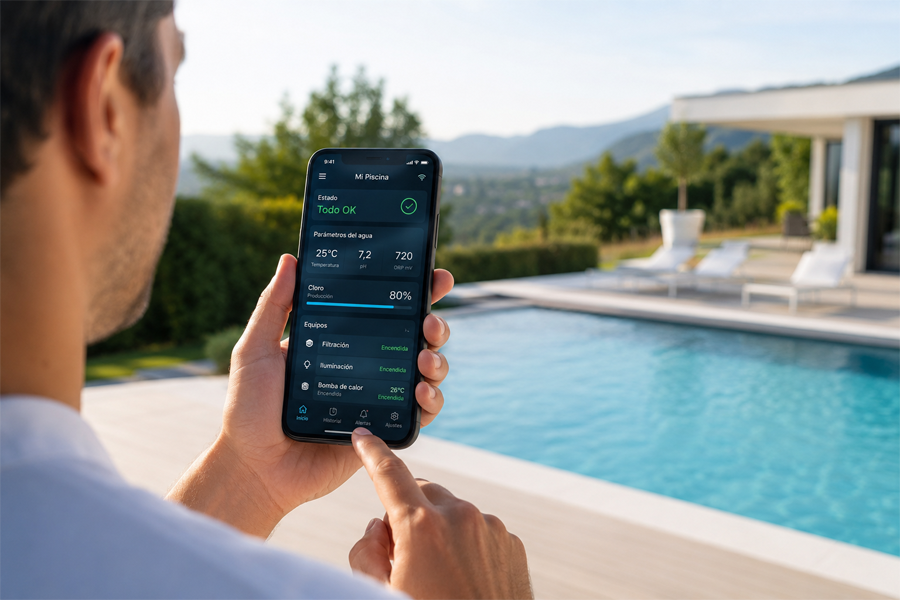
- Remote management from a mobile app.
The goal is to keep the water always within optimal values, ensuring effective disinfection and greater comfort for users.
Key benefits of automating a pool
1. Much more stable water quality
One of the biggest benefits of automation is keeping water parameters virtually constant.
Systems take continuous measurements and automatically correct deviations before they affect water quality.
As a result:
- Clearer water.
- Lower risk of algae growth.
- Greater disinfectant effectiveness.
- Greater stability throughout the season.
2. Lower chemical consumption
Automatic systems dose only the amount of product needed.
This prevents both overdosing and a lack of disinfectant, reducing the consumption of:
- Chlorine.
- pH correctors.
- Flocculants.
- Other auxiliary products.
In addition to cost savings, the environmental impact is minimized.
3. Greater convenience
With an automated system, many routine maintenance tasks disappear. There is no longer any need to measure water parameters daily or make constant manual adjustments.
The owner can spend more time enjoying the pool and less time maintaining it.
4. Greater health safety
Disinfection effectiveness depends directly on water balance.
When pH or disinfectant levels deviate from recommended values, the ability to eliminate microorganisms decreases.
Automation helps keep these parameters within optimal ranges for much longer.
5. Water savings
Properly balanced water requires fewer corrective treatments and fewer partial renewals.
This helps reduce water consumption, especially in heavily used pools.
6. Longer equipment lifespan
When the water remains properly balanced:
- limescale buildup decreases
- corrosion is reduced
- pumps operate under better conditions
- filters maintain more efficient operation
- treatment equipment suffers less wear
All of this translates into lower long-term maintenance costs.
7. Lower energy consumption
Automation doesn’t just control the water.
Many systems also allow you to manage:
- filtration schedules
- variable-speed pumps
- lighting
- heating
- other auxiliary equipment
Optimizing these processes can significantly reduce the pool’s electricity consumption.
Which systems can be automated?
Today, it’s possible to automate virtually any process related to water treatment. These are the most common:
Salt Chlorination
Salt electrolysis automatically produces the disinfectant needed from the salt dissolved in the water.
Combined with automatic pH control, it is one of the most efficient and convenient solutions.
Automatic pH dosing
Keeping pH within the recommended range is essential to ensure disinfectant effectiveness and swimmer comfort.
Automatic equipment continuously adjusts this parameter using high-precision measuring probes.
ORP (Redox) control
Redox potential indicates the water’s actual disinfecting capacity. Systems that incorporate this technology automatically adapt disinfectant production to the pool’s real needs.
Chemical dosing
Especially in public pools, continuous control and dosing of different chemicals is required to keep the water in proper condition. By automating this management, we optimize the use of these chemicals.
Filtration and pumps
Automation allows us to remotely manage the pool’s filtration and disinfection processes.
Remote monitoring
More and more manufacturers offer mobile apps that make it possible to:
- check the pool’s status;
- modify parameters;
- receive alerts;
- control different equipment from anywhere.
Automation and sustainability
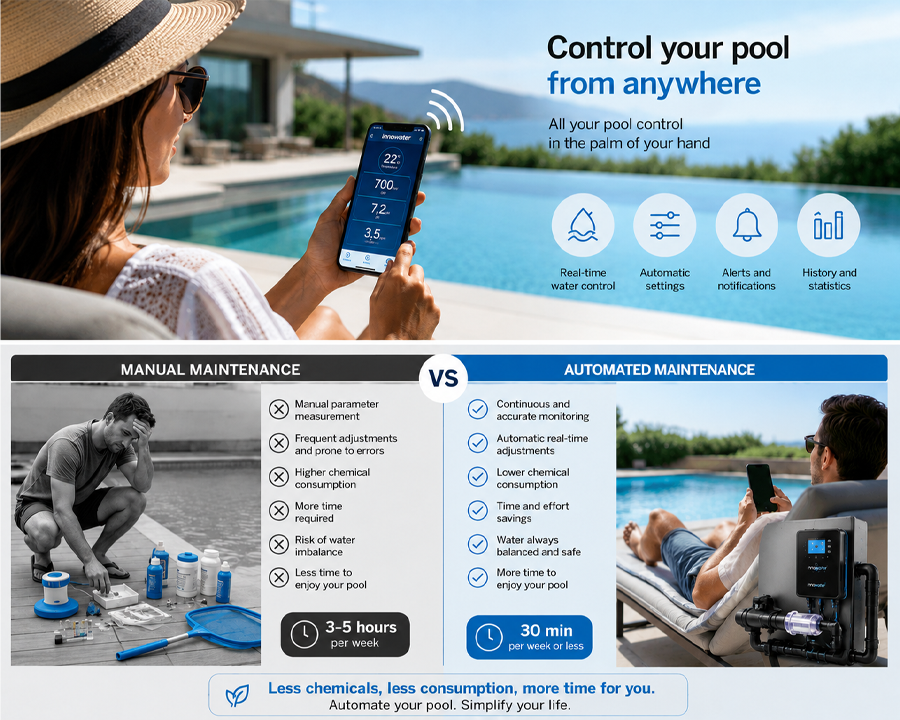
Thanks to automation, we can have more efficient and sustainable pools.
An automation system can allow us, for example, to:
- Reduce water consumption. By always having water in perfect condition, it deteriorates less and more slowly, resulting in significant savings.
- Reduce the use of chemicals, limiting their use only to times when it is strictly necessary.
- Optimize energy consumption. Equipment runs only when needed to keep the pool in perfect condition.
- Extend equipment lifespan. By optimizing operation, the different pieces of equipment last longer, operating under optimal conditions.
- Reduce environmental impact. With an automation system, we will be able to minimize the impact generated by pool operation. The pool becomes a more efficient and more sustainable element.
“Automation doesn’t replace pool maintenance; it makes it more precise, efficient, and sustainable”
Which types of pools benefit most?
Automation is especially recommended for:
- Family pools
- Community pools
- Hotels
- Campsites
- Sports centers
- Spas
- Heavily used pools.
The greater the pool use, the greater the advantages an automatic system provides.
Conclusion
Automating water treatment is one of the most cost-effective investments for any owner who wants to enjoy a more efficient, comfortable, and sustainable pool.
In addition to improving water quality, it makes it possible to reduce chemical consumption, lower energy costs, extend the lifespan of equipment, and greatly simplify daily maintenance.
If you’re thinking about refurbishing or modernizing your pool, adding an automation system is a decision that will continue to deliver benefits for many years.

Salt chlorination for pools is a treatment system that generates pure chlorine from the salt dissolved in the water, through an electrolysis process. A sustainable, automated, and safe treatment for swimming.
Related News
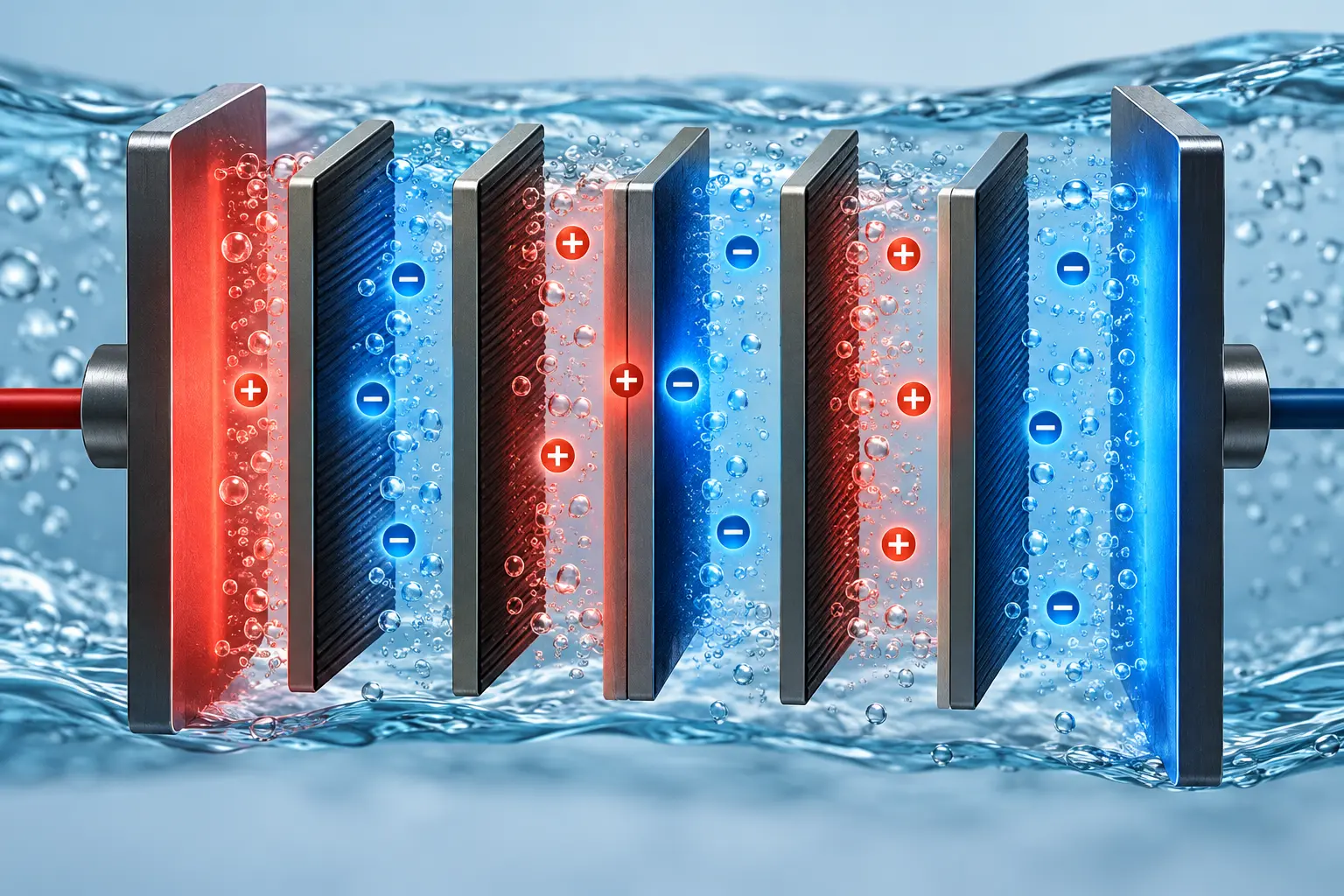
Bipolar cells, reverse polarity and programmable polarity in salt chlorination
Superchlorination or Boost Function in a Salt Chlorinator: What It Is, What It’s For, and When to Use It

Chloramines in Pools: What They Are, How They Form, and How to Eliminate Them
How to solve the 20 most frequent pool water problems
Complete guide to pool water treatment: all the parameters you need to control
Myths about Salt Chlorination: 10 Misconceptions You Need to Know
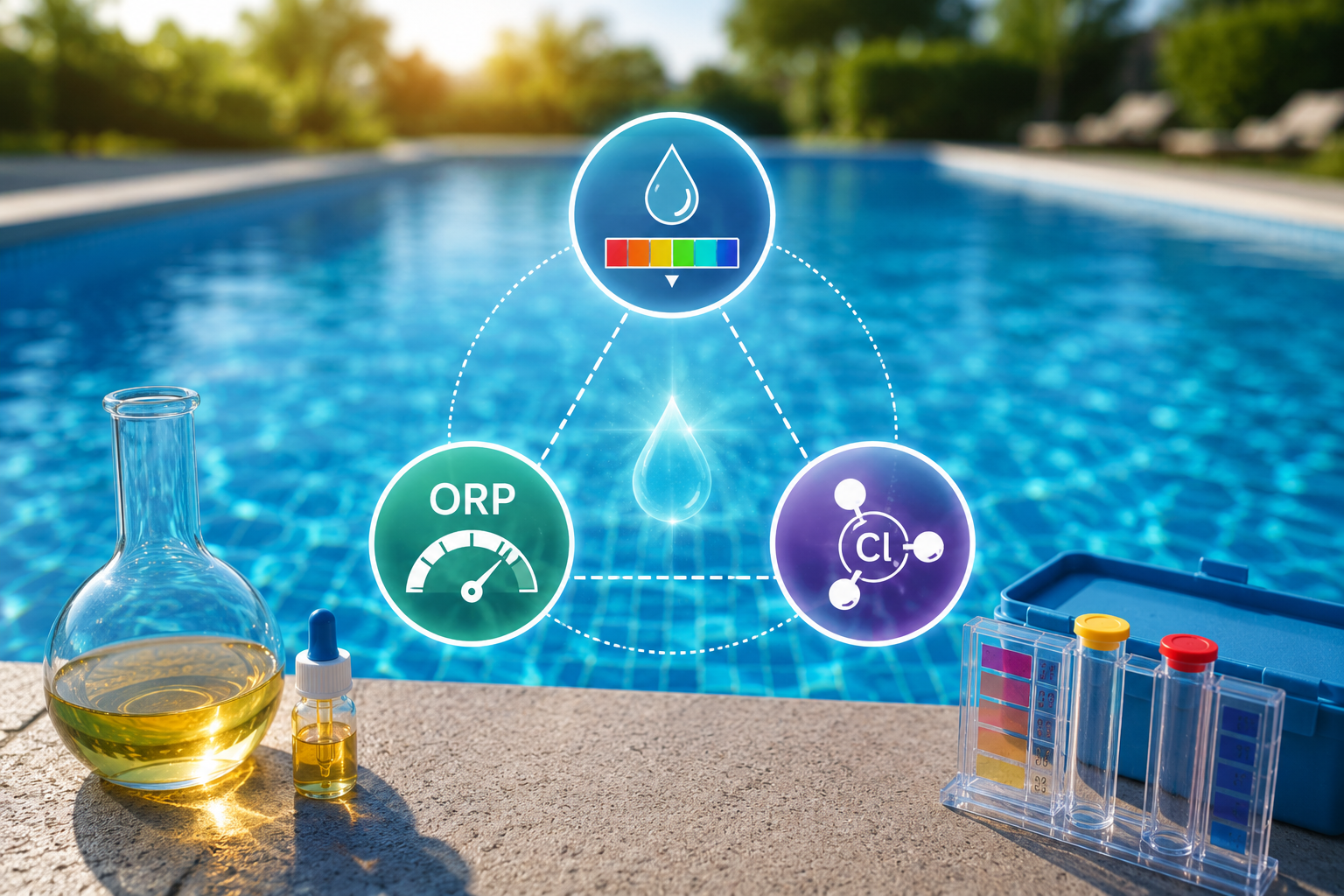
Relationship between pH, ORP, and free chlorine: The ultimate guide to achieving effective pool disinfection
How to correctly size a salt chlorinator for your pool: the ultimate guide to choosing the right equipment

What is ORP and why is it the most important parameter to ensure effective disinfection in a swimming pool?