Bipolar cells, reverse polarity and programmable polarity in salt chlorination
The cell is one of the key components of a salt chlorinator. Its design, electrodes, coating, and polarity management directly affect chlorine production, maintenance, and durability. Learn what a bipolar cell is, how reverse polarity works, and what programmable polarity adds.
It is in the electrolysis cell of a salt chlorinator that the electrochemical process takes place, transforming the chlorides present in salt water into active chlorine species capable of disinfecting pool water.
However, simply talking about a “salt chlorination cell” doesn’t really tell you how a unit works or what its long-term performance may be.
Among the technologies used today, bipolar cells, reverse polarity systems, and solutions with programmable polarity stand out.
But what does each concept mean, and what benefits does it offer? We explain it.
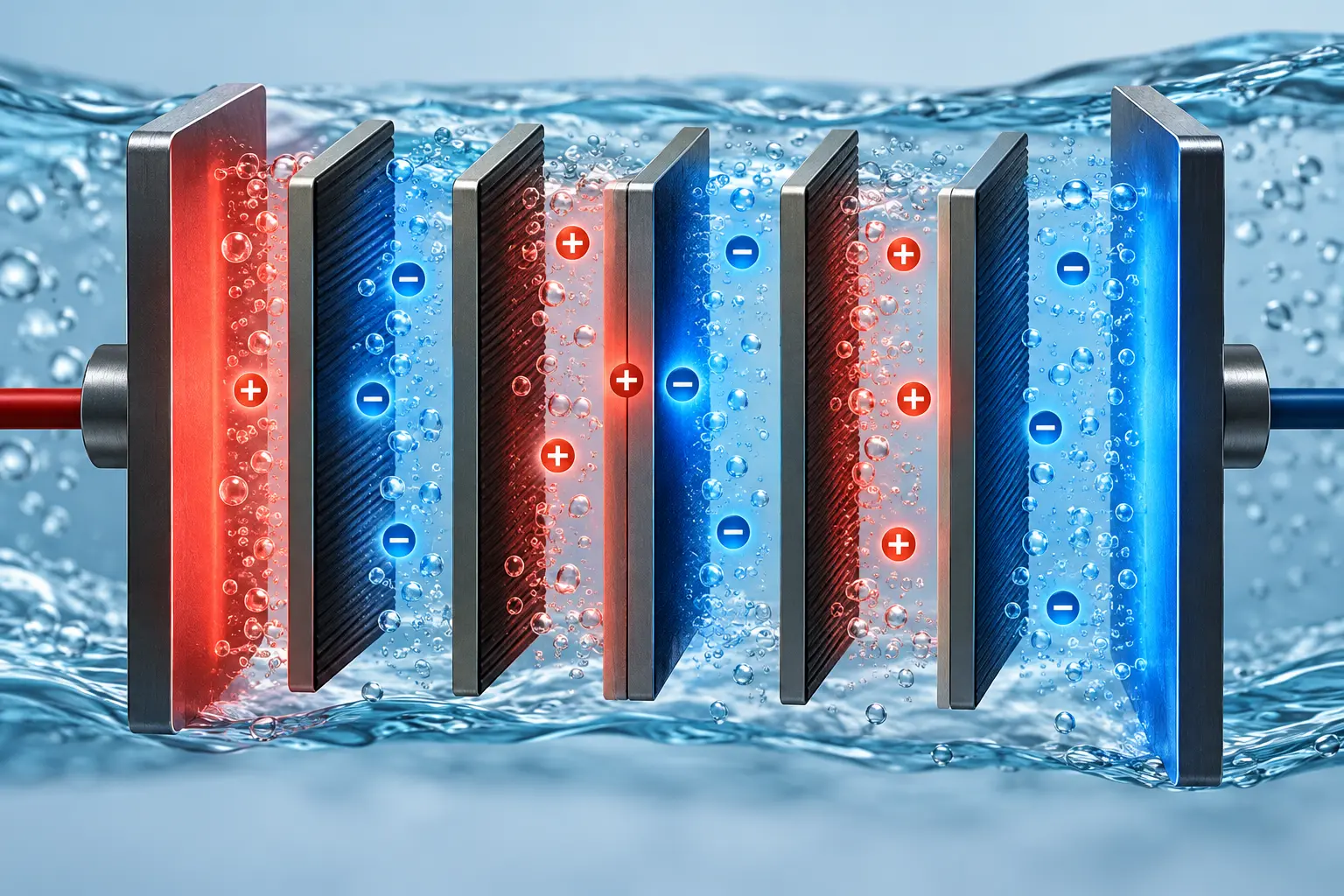
What is an electrolysis cell?
An electrolysis cell (electrolytic cell) is made up of one or more electrodes, usually made of titanium with a specific coating, through which the pool water flows.
When an electric current is applied, electrochemical reactions occur on the surface of these electrodes. In a salt chlorination system, the chloride ions present in the water take part in these reactions, generating active chlorine species that disinfect the water.
Simplified: Chlorides + water + electrical energy → active chlorine species
The efficiency of this process depends on multiple factors. That is the main reason why optimal electrolytic cell design becomes one of the key elements of a salt chlorinator.
What is a bipolar cell?
The term bipolar refers to the electrochemical configuration of the electrodes within the cell. In a bipolar configuration, the intermediate electrodes can behave anodically on one face and cathodically on the other when the corresponding electric field is established between the ends of the assembly.
This configuration makes it possible to use both faces of certain electrodes and develop compact cells with a large electrochemically active surface area.
The bipolar configuration must be assessed together with other cell design parameters, such as:
- Number of electrodes.
- Active surface area.
- Distance between electrodes.
- Material used.
- Type and quality of the coating.
- Current density.
- Cell hydrodynamics.
- Power supply and control system.
Therefore, the term “bipolar cell” describes a cell architecture, but on its own it is not synonymous with quality or efficiency.
What is polarity?
To understand polarity, you need to distinguish between the two electrical poles of the cell.
During electrolysis operation, certain surfaces act as the anode and others as the cathode. The reactions that take place on each surface are different. In salt electrolysis, these reactions generate the chlorine needed to disinfect the water.
But there is another important phenomenon: certain electrochemical conditions promote mineral precipitation on the electrode surfaces. One of the most common deposits is calcium carbonate (CaCO₃).
The build-up of these deposits can progressively reduce the active surface area and alter the cell’s operating conditions. This is where polarity reversal becomes especially important.
What is reverse polarity?
Reverse polarity is a technology in which the electronic system periodically reverses the polarity applied to the electrodes.
In simple terms, the surfaces that were operating under one polarity switch to the opposite polarity. This change alters the electrochemical conditions on the electrode surfaces and promotes the reduction and detachment of certain mineral scale deposits.
For this reason, cells that include this system are often also called self-cleaning cells.
Polarity reversal significantly reduces deposit build-up and decreases the cleaning interventions required. However, even though cell maintenance is reduced, it’s important to clarify that a reverse-polarity cell is not maintenance-free.
Proper water balance is still essential to ensure suitable operating conditions.
It’s important to follow some tips for maintaining a salt chlorinator cell.
What are the benefits of reverse polarity?
Automatic polarity reversal offers several benefits for the operation of a salt chlorinator:
- Reduced scaling. By periodically changing the electrodes’ electrochemical conditions, the tendency to accumulate certain mineral deposits is reduced. This is especially relevant in installations where the water has high calcium hardness.
- Less maintenance. Less scale build-up can reduce how often the cell needs to be cleaned. This makes maintenance easier and reduces the time spent on service operations.
- Maintained performance. Scale can reduce the effective electrode surface area and alter current transfer conditions. Keeping the surfaces in better condition helps preserve the cell’s production capacity.
- Electrode protection. Prolonged deposit build-up can negatively affect cell operation. Polarity reversal helps minimize this issue and can support longer service life when used within the design parameters set by the manufacturer.
What is programmable polarity?
Programmable polarity makes it possible to manage the interval between polarity changes according to a configuration set by the control system. This is an evolution compared to systems that use a single fixed interval.
Why can it be useful?
Mainly because operating conditions are not the same in every pool. Water hardness, temperature, salt concentration, operating hours, and production intensity can vary considerably from one installation to another.
Therefore, having a polarity management strategy tailored to the system helps us optimize cell operation.

Why isn’t there a single ideal reversal interval?
The optimal reversal frequency depends on different variables. Some of the most relevant are:
- Water calcium hardness.
- pH.
- Alkalinity.
- Temperature.
- Salinity.
- Current intensity.
- Current density.
- Operating hours.
- Cell design.
- Electrode characteristics.
Reversing too infrequently can promote deposit build-up. On the other hand, reversing unnecessarily often is not the best strategy for all cell designs.
That’s why it’s so important for electronic polarity management to be part of the overall electrolysis system design.
Differences between reverse polarity and programmable polarity
Although they are related, reverse polarity and programmable polarity are not synonyms:
- Reverse polarity refers to the system’s ability to change the polarity of the electrodes.
- Programmable polarity adds the ability to manage when or how often that change occurs, according to the implemented control strategy.
| Technology | Main function |
| Fixed polarity | Maintains a specific electrical configuration |
| Reverse polarity | Periodically reverses polarity |
| Programmable polarity | Allows management of reversal intervals |
| Advanced electronic control | Coordinates polarity, current and output |
As you would expect, availability and configuration options depend on each manufacturer’s and model’s design.
Innowater salt chlorinators, in addition to featuring bipolar cells, also include programmable polarity.
How does polarity affect a cell’s efficiency?
The efficiency of an electrolysis cell does not depend solely on the electrical power applied. You also need to consider how that energy is used to produce chlorine and the conditions under which the cell operates.
An electrode surface with deposits operates under different conditions than a completely clean electrode surface.
Proper polarity management helps keep electrochemically active surfaces in better condition and can help maintain stable output.
For this reason, when discussing efficiency in salt electrolysis, it’s advisable to assess together:
- Chlorine production.
- Power consumption.
- Current density.
- Active surface area.
- Cell design.
- Polarity management.
- Hydraulic conditions.
- Water quality.
The importance of current density
One of the key parameters for understanding a cell’s behavior is current density. In short, it relates the applied electric current to the available electrochemically active surface area.
A given chlorine output can be achieved with different cell configurations. Electrode design and active surface area determine the current density at which the system operates.
In this way, good engineering seeks a balance between:
- Chlorine production.
- Electrode surface area.
- Current density.
- Energy consumption.
- Coating durability.
- Thermal management.
- Cell service life.
For this reason, nominal chlorine output, expressed only in grams per hour, is not enough to compare two electrolysis technologies.
Titanium coating: another key factor
The electrodes in many electrolysis cells on the market are made of titanium. This is mainly due to its mechanical properties and corrosion resistance.
However, titanium alone does not determine the electrode’s electrochemical behavior.
The surface includes an electrocatalytic coating that plays a key role in electrolysis reactions.
At Innowater, we opt for ruthenium coatings for several reasons:
- Exceptional corrosion resistance, acting as a catalyst in chlorine production.
- Major reduction in power consumption.
- Extended service life of the electrolytic cell.
Its composition, structure, thickness, manufacturing process, and operating conditions will directly influence aspects such as:
- Electrochemical activity.
- Efficiency.
- Wear resistance.
- Stability.
- Electrode service life.
In this way, the cell’s manufacturing technology is essential when evaluating a salt chlorination system.
Does reverse polarity completely eliminate the need for maintenance?
No. Polarity reversal is a technological tool to reduce deposit build-up, but it does not replace proper pool maintenance.
Water parameters must be kept within the values recommended by the manufacturer. These are especially important:
- pH.
- Alkalinity.
- Calcium hardness.
- Salinity.
- Temperature.
- Stabilizer concentration, where applicable.
Properly balanced water supports cell operation and helps extend its service life.
Does reverse polarity increase a cell’s service life?
It naturally helps preserve the cell electrode’s operating conditions, but service life also depends on many other factors.
Among the most important are:
- Cell design
- Coating quality
- Current density
- Water conditions
- Operating hours
- Control strategy.
For this reason, it is not correct to automatically associate a given polarity technology with a specific service life. Durability must be evaluated within the overall cell engineering.
Bipolar cell, reverse polarity and control: a holistic view
A cell’s electrolysis technology should not be assessed using a single parameter. An advanced solution combines different elements:
- Electrochemical design. The electrode configuration determines how electrolysis takes place.
- Materials. Titanium and the electrocatalytic coating are essential for performance and durability.
- Active surface area. Together with other parameters, it determines the current density at which the cell operates.
- Polarity management. Polarity reversal helps control scale formation.
- Electronic control. It makes it possible to manage current, output, and operating cycles according to the system’s needs.
- Control of water parameters. Proper water quality is essential for stable operation.
It is the combination of all these factors that determines the real-world performance of a salt chlorination technology.

What are the benefits of advanced cell technology?
A properly designed and controlled cell can offer benefits for both the user and the professional responsible for the installation:
- Greater output stability. Proper cell management helps maintain more consistent operating conditions.
- Less deposit build-up. Polarity reversal reduces scale formation on the electrodes.
- Less maintenance required. Reducing deposits can decrease how often cleaning interventions are needed.
- Better use of active surface area. Proper electrode configuration helps optimize electrochemical conditions.
- More precise control. Control electronics allow output to be adapted to the pool’s actual needs.
- Greater durability. Proper electrode design and operation within the intended parameters can help extend service life.

“An efficient electrolysis cell must do more than produce chlorine: it must do so stably, in a controlled way, and sustainably over time”
The cell: the technological heart of a salt chlorinator
Generating chlorine by electrolysis looks simple from the outside: water, salt, and electricity. However, behind this process is complex electrochemical technology involving multiple variables.
The bipolar cell, polarity reversal, programmable cycle management, current density, electrode coating, and electronic control are elements that must be designed together.
Good electrolysis technology is not just about producing a certain amount of chlorine. It’s about achieving that output stably, in a controlled way, and efficiently, while maintaining proper electrode conditions and reducing maintenance needs.
That’s why, when comparing different salt chlorination systems, it’s important to go beyond simply looking at the salt chlorinator’s nominal output expressed in grams of chlorine per hour—for example, by analyzing how the electrolysis cell is designed and controlled.
Frequently asked questions
Here are some of the most common questions related to a salt chlorinator’s electrolytic cell:
- What is a bipolar cell? It is an electrolysis cell configuration in which certain intermediate electrodes exhibit different electrochemical behavior on each face when the electric field is established.
- What is reverse polarity in a salt chlorinator? It is the periodic reversal of the electrical polarity applied to the electrodes to change electrochemical conditions and reduce the build-up of certain mineral deposits.
- What does it mean for a cell to be self-cleaning? It generally means it includes a polarity reversal system that helps reduce scaling on the electrodes.
- What is programmable polarity? It is a system that allows polarity reversal intervals to be managed according to a specific control strategy.
- Does reverse polarity prevent limescale from forming? It helps reduce deposit build-up, but it does not eliminate the influence of water hardness or replace proper balancing of chemical parameters.
- Does reverse polarity increase a cell’s service life? It can help keep the electrodes in better condition, although service life also depends on design, coating, current density, operating hours, and water quality.
- Is a bipolar cell more efficient? Efficiency cannot be determined solely by the bipolar configuration. You need to assess electrode design, active surface area, current density, coating, consumption, control, and operating conditions together.
- What factors determine the efficiency of a salt chlorinator? Among others: cell technology, electrode surface area, current density, electrocatalytic coating, chlorine output, power consumption, polarity management, and the control system.

Salt chlorination for pools is a treatment system that generates pure chlorine from the salt dissolved in the water, through an electrolysis process. A sustainable, automated, and safe treatment for swimming.
Related News

Superchlorination or Boost Function in a Salt Chlorinator: What It Is, What It’s For, and When to Use It

Chloramines in Pools: What They Are, How They Form, and How to Eliminate Them

How to solve the 20 most frequent pool water problems
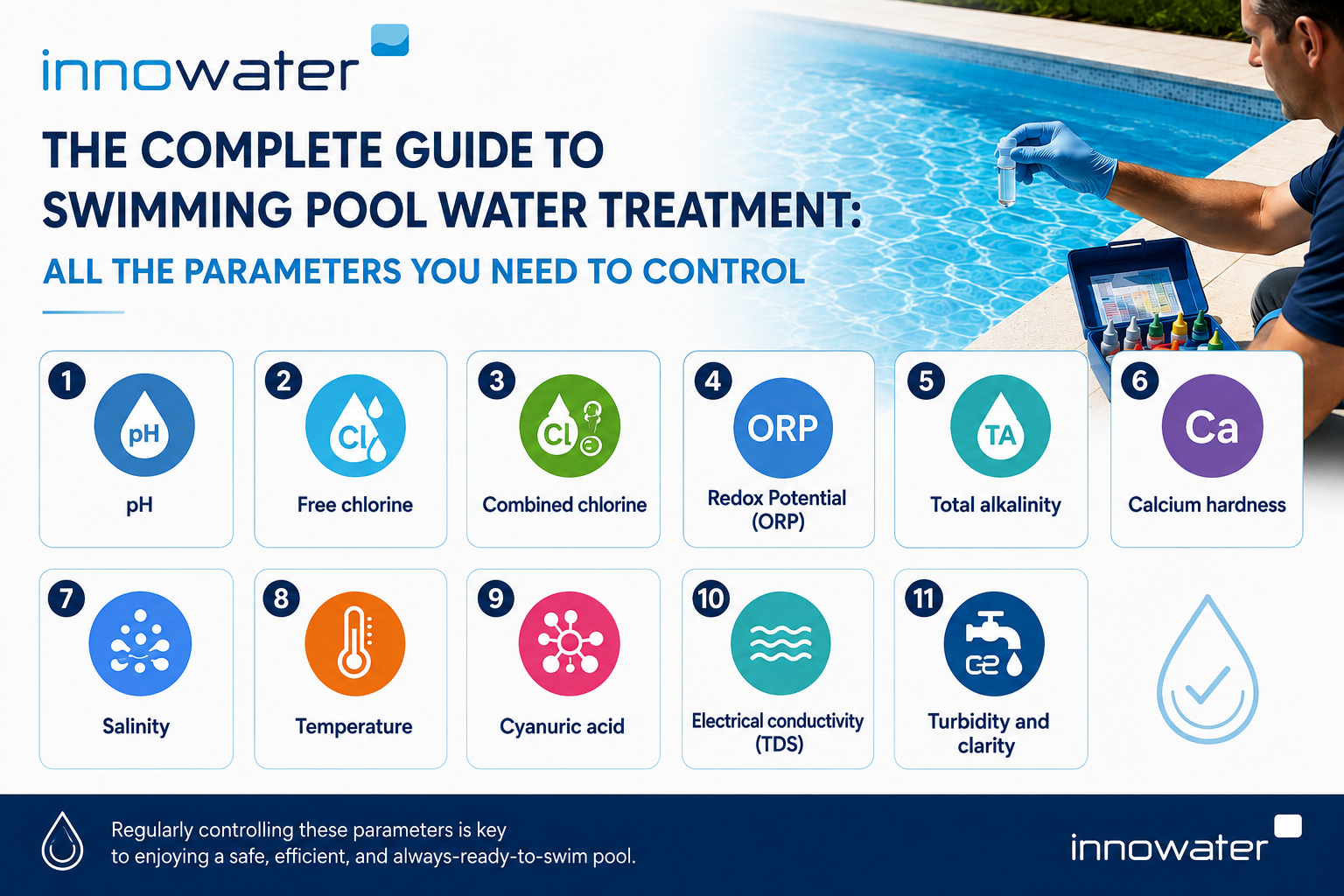
Complete guide to pool water treatment: all the parameters you need to control
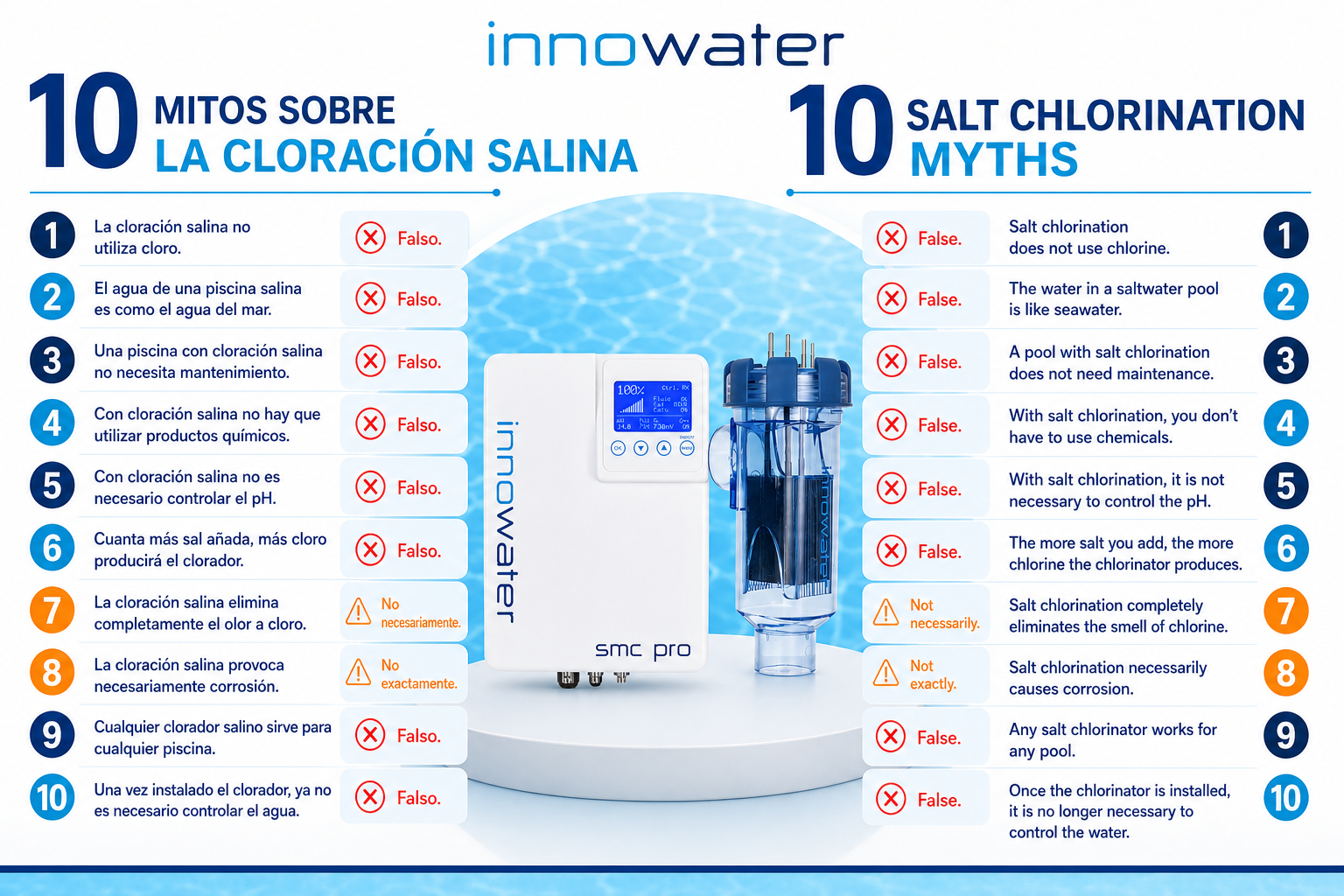
Myths about Salt Chlorination: 10 Misconceptions You Need to Know
Relationship between pH, ORP, and free chlorine: The ultimate guide to achieving effective pool disinfection
How to correctly size a salt chlorinator for your pool: the ultimate guide to choosing the right equipment

What is ORP and why is it the most important parameter to ensure effective disinfection in a swimming pool?
Automating pool water treatment: greater efficiency, less maintenance, and consistently high water quality