Chloramines in Pools: What They Are, How They Form, and How to Eliminate Them
Chloramines, also known as combined chlorine, are one of the parameters that should be monitored to assess pool water quality. They form when chlorine reacts with contaminants primarily introduced by bathers, such as sweat, urine, skin cells, cosmetics, and organic matter.
Their accumulation can lead to intense chlorine odor, eye and skin irritation, and respiratory discomfort, especially in indoor pools.
But what exactly are they? Why do they appear? Do they also form in pools with salt chlorination? And how can they be eliminated?
What are Chloramines or Combined Chlorine?
In a pool, we can differentiate three concepts:
- Free chlorine: the fraction available to perform disinfection.
- Combined chlorine: chlorine that has reacted with contaminants and forms, among other compounds, chloramines.
- Total chlorine: the sum of free chlorine and combined chlorine.
Therefore: Combined chlorine = Total chlorine − Free chlorine
Combined chlorine generally has a lower disinfectant capacity than free chlorine. Its elevated presence indicates an accumulation of reaction products that should be controlled.
How do chloramines form?
The process begins when the chlorine present in the water reacts with nitrogenous compounds mainly from bathers. Key precursors include:
- Sweat.
- Urine.
- Skin cells.
- Cosmetics and hygiene products.
- Organic matter.
These reactions can generate different types of chloramines, including monochloramine, dichloramine, and trichloramine. The latter is especially relevant in indoor pools because it can transfer from water to air.
Simply put: Chlorine + contaminants → chloramines
Therefore, the greater the contaminant load and the poorer its removal, the greater the accumulation of combined chlorine can be.
Why does a pool smell of chlorine?
One of the most widespread ideas is that “if a pool smells strongly of chlorine, it has too much chlorine”.
This is not necessarily true. The characteristic strong odor we associate with certain pools is usually related to the presence of chloramines, not simply an excess of free chlorine.
When chlorine reacts with contaminants introduced by bathers, some of that chlorine becomes combined. Therefore, a pool can have an intense odor even without an excessively high level of free chlorine.
How do chloramines affect water quality?
A high concentration of chloramines can affect both water quality and the environment around the pool.
- Eye irritation. Red, irritated, or stinging eyes can be related to the presence of chloramines.
- Skin irritation. Exposure to certain compounds present in the water can contribute to discomfort and skin irritation.
- Respiratory tract irritation. Volatile chloramines can become airborne and cause nasal irritation, coughing, or respiratory discomfort. This problem is particularly important in indoor pools with insufficient ventilation.
- Unpleasant odor. The characteristic “pool smell” can be a sign of chloramine accumulation.
- Reduced availability of disinfectant chlorine. When part of the chlorine is combined, there is less free chlorine available to effectively perform its disinfectant function.
Do chloramines also appear in pools with salt chlorination?
Yes, of course. This is one of the most important ideas to clarify: Salt chlorination does not automatically eliminate chloramine formation.
In a pool equipped with a salt chlorinator, electrolysis generates active chlorine species from the salt dissolved in the water. Once generated, this chlorine participates in the same chemical reactions with contaminants introduced by bathers. Therefore:
- Conventional pool → chlorine + contaminants → chloramines
- Pool with salt chlorination → chlorine generated by electrolysis + contaminants → chloramines
The fundamental difference lies in how chlorine is generated and added to the water, not in the disappearance of the chemistry of combined chlorine formation.
Therefore, a pool with salt chlorination also needs to control free chlorine, combined chlorine, pH, and other water quality parameters.
The specific values must comply with applicable regulations, the type of installation, and the manufacturer’s instructions.
As a reference, the CDC’s Model Aquatic Health Code uses 0.4 ppm of combined chlorine as an action concentration for aquatic facilities. The same document states that the WHO considers it desirable to keep it as low as possible, ideally below 0.2 mg/L.
How is combined chlorine measured?
Combined chlorine is usually not measured as a single specific compound, but rather obtained from the difference between total chlorine and free chlorine.
The formula is: Combined chlorine = Total chlorine − Free chlorine
For example:
- Total chlorine: 2.0 ppm
- Free chlorine: 1.6 ppm
- Combined chlorine: 0.4 ppm
Consequently, controlling only free chlorine does not always provide a complete picture of water quality. It is advisable to also control combined chlorine, especially in heavily used pools.
Why does combined chlorine increase?
Various factors can contribute to its accumulation:
- High bather load. The more people use the pool, the greater the amount of sweat, skin cells, cosmetics, and other contaminants that enter the water.
- Lack of prior hygiene. Showering before swimming significantly reduces the amount of contaminants that enter the water. The CDC even recommends a brief shower before entering the pool.
- Presence of organic matter. Dirt, leaves, plant debris, and other contaminants increase the oxidation demand.
- Insufficient chlorine. If the amount of free chlorine available is not sufficient to meet the water’s demand, reaction products can accumulate.
- Unbalanced pH. pH directly influences chlorine effectiveness and water chemical balance. High pH reduces chlorine’s disinfectant capacity.
- Deficient filtration. Insufficient filtration can promote the accumulation of contaminants and organic matter in the water.
- Insufficient water renewal. In certain facilities, partial water renewal helps reduce the accumulation of specific contaminants.
How to eliminate or reduce chloramines?
The most effective strategy is not just adding more chemicals. It’s about preventing their formation and promoting the elimination of those already present.
1. Reduce contaminant entry
Prevention is key. Some simple measures include:
- Shower before entering the pool.
- Do not urinate in the water.
- Maintain proper bather hygiene.
- Properly clean the pool basins and surroundings.
- Control bather load.
- Maintain good filtration.
Users themselves play an important role in preventing chloramines.
2. Maintain correct pH
Balanced pH allows chlorine to work more effectively and helps maintain stable water treatment.
3. Perform oxidation or superchlorination
When the combined chlorine level is high, an oxidation treatment may be necessary.
Superchlorination, also known as breakpoint chlorination, uses a high concentration of chlorine to oxidize the compounds responsible for combined chlorine. This procedure must always comply with local regulations and manufacturer’s instructions.
4. Use complementary treatment systems
In certain facilities, complementary technologies can be used, such as:
- UV radiation
- Ozone
- Complementary oxidation systems
- Advanced water treatments
UV and ozone systems can help reduce certain chloramines and complement the main treatment.
These technologies do not necessarily replace the residual disinfectant but can be used as part of a comprehensive treatment strategy.
5. Improve ventilation in indoor pools
In indoor pools, adequate ventilation is especially important to prevent the accumulation of airborne chloramines.
Can a pool have low chlorine and high chloramines?
Yes. This is another common misconception. A pool can simultaneously exhibit:
- Low free chlorine.
- High combined chlorine.
- Strong “chlorine” odor.
- Eye or skin irritation.
In this case, simply adding more chlorine without analyzing the problem may not be sufficient.
It is necessary to determine why the water is rapidly consuming chlorine and address the cause: organic load, pH, filtration, contamination, lack of oxidation, etc.
How to prevent chloramines in a pool with salt chlorination?
In a saltwater electrolysis pool, some good practices are especially important:
An effective water treatment must combine:
-
- Free chlorine control.
- Combined chlorine control.
- pH regulation.
- ORP control, when the system uses it.
- Correct chlorinator sizing.
- Adequate filtration.
- Oxidation or Superchlorination when necessary.
- Appropriate water renewal.
Chloramines: the problem isn’t having chlorine, but how it’s used
Chlorine is essential for keeping a pool disinfected. The problem arises when chlorine reacts with contaminants introduced into the water, forming combined chlorine compounds. Therefore, a good treatment strategy should aim for three objectives:
- Maintain adequate disinfection.
- Reduce the amount of contaminants entering the water.
- Prevent chloramine accumulation through adequate oxidation, filtration, and renewal.
This applies to both a pool treated with conventional dosing and a pool equipped with salt chlorination.
“The important thing is not just knowing how much chlorine is in the water, but what that chlorine is doing.”
Frequently asked questions about chloramines in pools
What are chloramines?
They are compounds formed when chlorine reacts with certain contaminants present in the water, especially nitrogenous compounds. In pool control, they are part of what is known as combined chlorine.
Are chloramines the same as combined chlorine?
In the context of pool treatment, the terms are often used almost interchangeably, although chemically, combined chlorine can include different chlorinated species.
Why does a pool smell strongly of chlorine?
A strong “chlorine” odor is usually related to the presence of chloramines, especially when there is a high bather load or insufficient ventilation.
Does salt chlorination eliminate chloramines?
Not automatically. Salt electrolysis generates active chlorine, but that chlorine can react with contaminants and form chloramines.
How are chloramines eliminated?
Depending on the situation, prevention measures, oxidation or superchlorination, filtration, partial water renewal, and complementary technologies like UV or ozone can be used.
Should combined chlorine be measured?
Yes. Controlling only free chlorine does not provide all the necessary information about the water’s condition. Combined chlorine is usually calculated from total chlorine and free chlorine.
Conclusion
Chloramines are a fundamental parameter for evaluating pool water quality.
They form mainly when chlorine reacts with contaminants introduced by bathers and can be behind the intense chlorine odor, irritation, and certain air quality problems.
The solution is not simply to add more chlorine. It is necessary to combine disinfection, pH control, filtration, oxidation, water renewal, and contamination prevention.
And in a pool with salt chlorination, one idea must be clear: Electrolysis generates chlorine, but it does not eliminate the chemistry of chloramines.
Therefore, correctly controlling free chlorine, combined chlorine, pH, and ORP is key to achieving cleaner, more stable, and healthier water.

Salt chlorination for pools is a treatment system that generates pure chlorine from the salt dissolved in the water, through an electrolysis process. A sustainable, automated, and safe treatment for swimming.
Related News
Bipolar cells, reverse polarity and programmable polarity in salt chlorination
Superchlorination or Boost Function in a Salt Chlorinator: What It Is, What It’s For, and When to Use It
How to solve the 20 most frequent pool water problems
Complete guide to pool water treatment: all the parameters you need to control
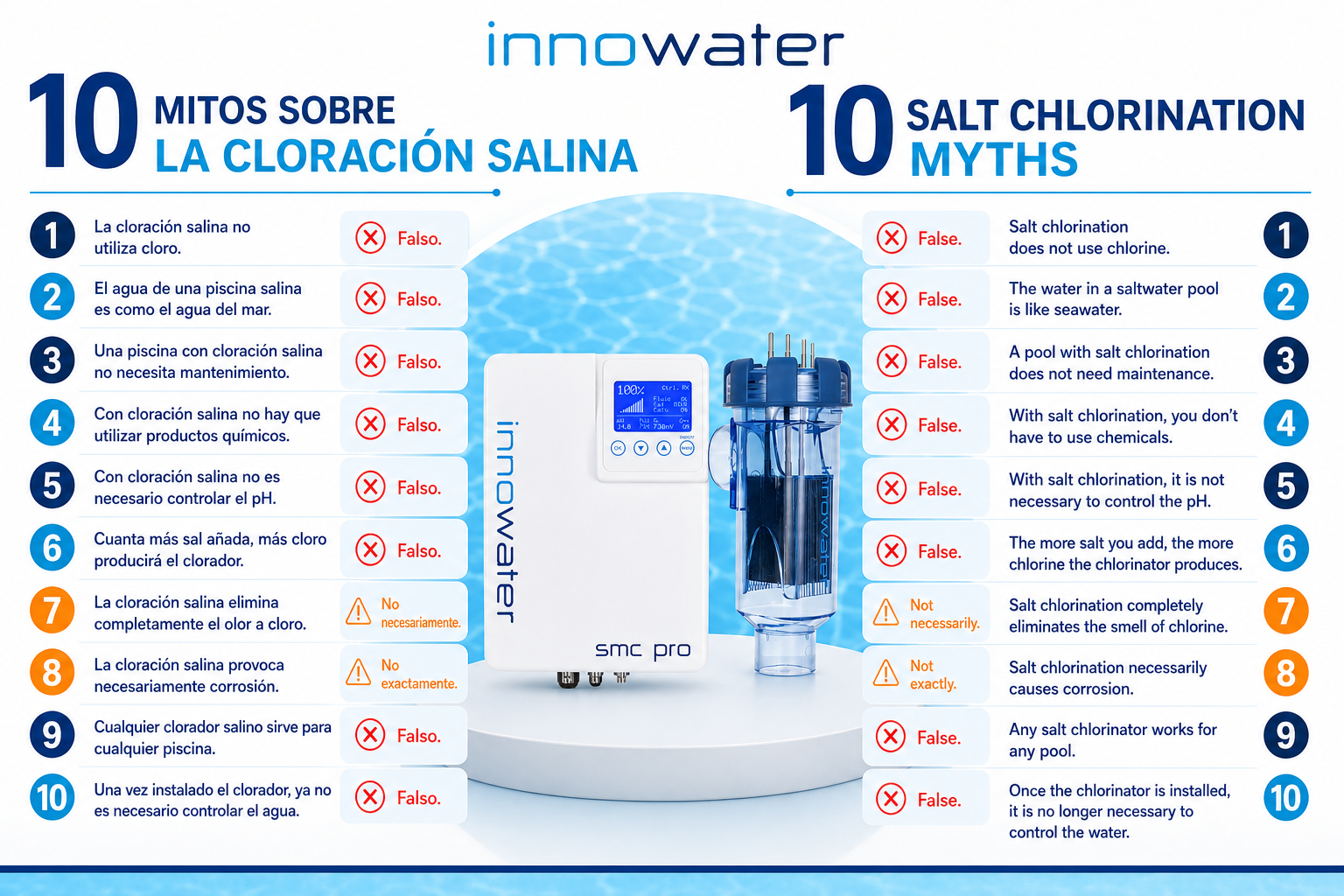
Myths about Salt Chlorination: 10 Misconceptions You Need to Know
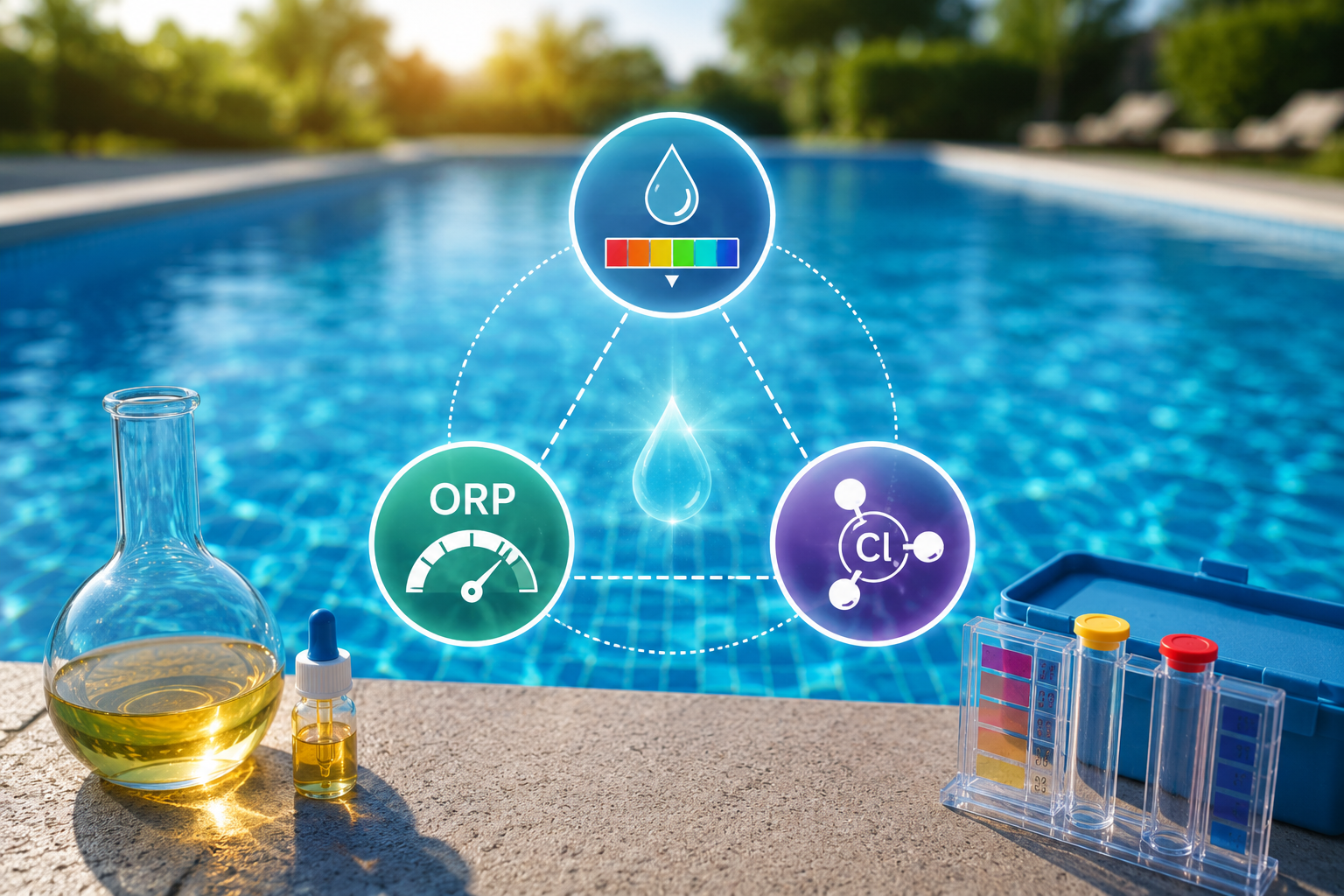
Relationship between pH, ORP, and free chlorine: The ultimate guide to achieving effective pool disinfection
How to correctly size a salt chlorinator for your pool: the ultimate guide to choosing the right equipment

What is ORP and why is it the most important parameter to ensure effective disinfection in a swimming pool?
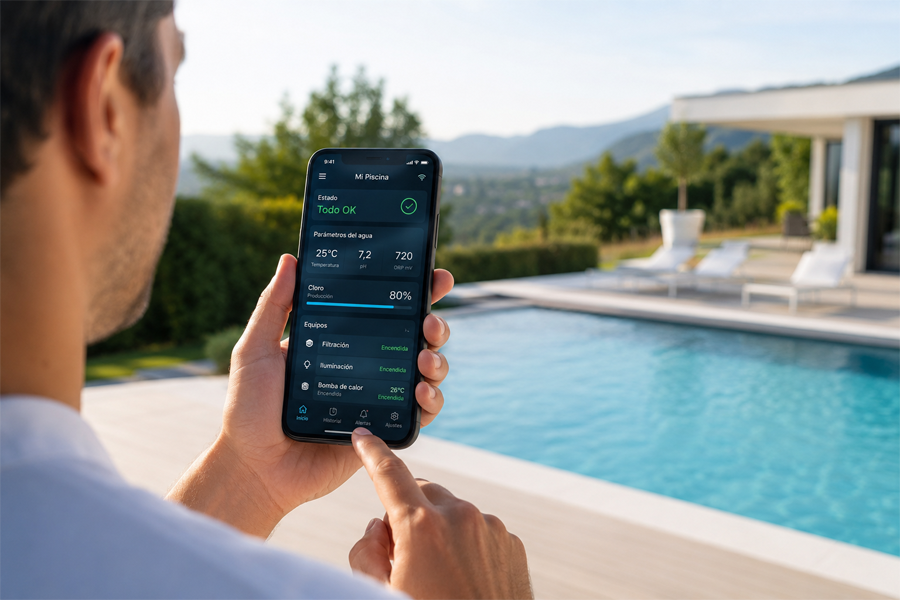
Automating pool water treatment: greater efficiency, less maintenance, and consistently high water quality