How to design a salt chlorination system for a public pool
Designing the salt chlorination system for a public pool isn’t simply a matter of knowing how many cubic meters of water the pool holds and choosing equipment to cover that volume.
In a collectively used installation, many more factors come into play: number of bathers, operating hours, filtration time, water temperature, sun exposure, installation characteristics, intensity of use, and the treatment control system.
That’s why two pools with the same volume can need completely different chlorine production equipment.
In a private pool, volume can serve as a first approximation. In a public pool, on the other hand, sizing must be based on the installation’s actual operating conditions. Innowater’s own technical documentation recommends considering, in addition to volume, parameters such as the number of daily bathers and filtration hours.
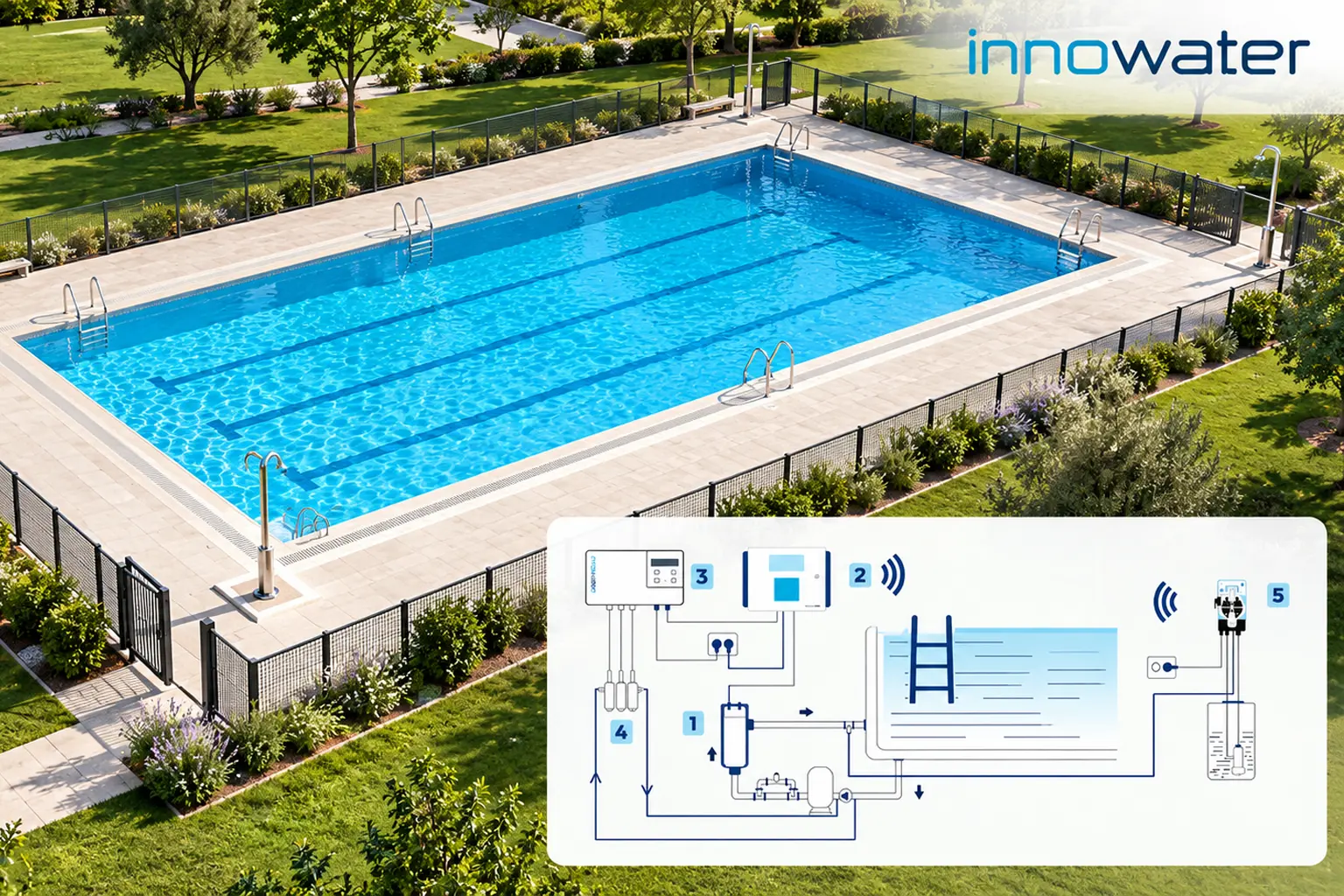
The first step: understanding how the pool will operate
Before talking about models or production capacities, it’s worth gathering all the available information about the installation.
At a minimum, the project should take into account:
- Actual water volume.
- Filtration flow rate.
- Filtration operating hours.
- Approximate number of daily bathers.
- Usual water temperature.
- Outdoor or indoor pool.
- Intensity of use.
- Time of year the installation operates.
- Characteristics of the hydraulic system.
- Space available for installing the equipment.
- Need to automate pH and ORP control.
- Possibility of integrating the system with a monitoring or management platform.
This information makes it possible to move from a selection based solely on cubic meters to sizing adapted to the actual situation.
Water volume matters, but it’s not enough
Volume is the starting point because it determines the amount of water that needs to be treated. However, it doesn’t on its own indicate how much disinfectant a pool needs.
An outdoor pool of 500 m³ with high bather traffic can have very different requirements from another 500 m³ pool used moderately.
The scenario also changes considerably depending on whether the installation runs 12 hours a day or the filtration works 24 hours a day.
The chlorine production system itself is constrained by the hours available to produce it. If the operating time is short, a higher production capacity will be needed to generate the required amount of chlorine in that period.
That’s why the calculation must take volume, use, and operating time into account together.
The number of bathers completely changes the sizing
In a public pool, this is one of the factors that most sets the calculation apart from that of a residential pool.
Each bather introduces organic matter into the water. Sweat, cosmetics, and other contaminants increase disinfectant demand and force the treatment system to respond to load variations that can be significant throughout the day.
A municipal pool with hundreds of daily users doesn’t need the same production capacity as a pool at a small tourist accommodation.
What’s more, occupancy is usually not constant. There can be a significant difference between a weekday and a weekend, or between normal operation and a period of peak occupancy.
That’s why, when designing the system, it’s best to work with the most demanding conditions of use that are likely to occur regularly, not just with the average situation.
Filtration hours matter too
Chlorine production is linked to the operation of the electrolytic cell and, therefore, to the circulation of water through the system.
An installation with many operating hours can spread production throughout the day. In a pool where the filtration system runs for less time, the production capacity needed during those hours will be higher.
This is one of the reasons why it doesn’t make sense to select a chlorinator based solely on a fixed ratio between cubic meters of water and grams of chlorine per hour.
Innowater’s recommendation documentation for public pools specifically distinguishes between configurations based on filtration hours, in addition to taking into account volume and the number of daily bathers.
Outdoor or indoor pool
The pool’s location is also an important aspect to consider.
- In an outdoor installation, sunlight affects how the disinfectant behaves, and environmental conditions are far more variable. Temperature, UV radiation, rain, wind, and pollution can all change treatment requirements.
- In an indoor pool, conditions tend to be more stable, although high water temperature and intensive use can also create considerable demand.
That’s why applying the same sizing criteria directly to both an outdoor and an indoor pool can lead to an incorrect selection.
Water temperature is another decisive factor
As water temperature rises, treatment requirements can increase as well.
In heated installations, spas, indoor pools, or certain intensively used pools, this aspect becomes even more important. Temperature must be analyzed together with the other variables. It doesn’t make sense to consider volume alone and then apply a separate correction for temperature.
The goal is to know as much as possible about the actual conditions the system will have to operate under during periods of highest demand.
How many grams of chlorine per hour does a public pool need?
This is probably the question that interests professionals most when they start sizing an installation. The answer can’t be a fixed number.
The chlorinator’s capacity must be set based on the pool’s specific characteristics and how it operates. In fact, Innowater has a specific table for public pools that relates volume, number of bathers, and filtration hours to guide equipment selection.
Not only that, we also offer an exclusive online calculator that lets you assess the best option for your pool.
In larger installations, the required capacity can reach several hundred grams of Cl₂ per hour.
The SMC-M range, for example, currently offers models of 75, 100, 150, and 180 g Cl₂/h, designed for medium-sized public pools with intensive use.
For higher-capacity installations, the SMC-H range offers models of 250, 300, 500, 750, and 1,000 g Cl₂/h.
This makes it possible to match production to installations with very different needs without having to rely on a single large-capacity model.
A practical sizing example
Let’s imagine an outdoor pool of 500 m³ that receives approximately 200 bathers a day.
At first glance, it might seem enough to look for a chlorinator rated for 500 m³. However, that information alone isn’t enough to make a correct selection.
You also need to know how many hours the filtration runs and how intensively the pool is used.
Innowater’s recommendation table addresses exactly this kind of situation. For an outdoor pool of 500 m³ with 200 daily bathers, different configurations appear depending on whether the installation runs with 12 or 24 hours of filtration.
This difference matters because it shows something that’s often overlooked in projects: the same pool may need a different configuration depending on how the installation is operated.
That’s why, before selecting the equipment, it’s best to define the operating conditions rather than simply looking for a model based on volume.
Is it better to oversize the salt chlorinator?
In professional installations, it’s usually worthwhile to have some capacity margin. The reason is simple: actual conditions don’t always match the average conditions used during design.
Situations such as an increase in bathers, a heatwave, a rise in water temperature, or more intensive use may occur during certain periods.
Equipment with sufficient capacity, with some margin, lets us handle these situations without the equipment having to run at the limit of its output all the time.
This doesn’t mean we have to install the largest equipment available. Excessive oversizing doesn’t necessarily offer an advantage either. In fact, it can unnecessarily increase the initial investment.
The key is to size the system by finding a balance between expected demand, the most demanding operating conditions, and the system’s regulation capacity.
Salt chlorination shouldn’t work in isolation
Installing a salt chlorinator doesn’t mean the water treatment is completely automated.
The electrolytic cell generates the disinfectant from salt, but other water parameters still need to be controlled. pH, for example, directly affects chlorine’s effectiveness and must be kept within the right range.
In public installations, it’s also especially worthwhile to have continuous measurement of certain parameters and systems capable of acting automatically when deviations occur.
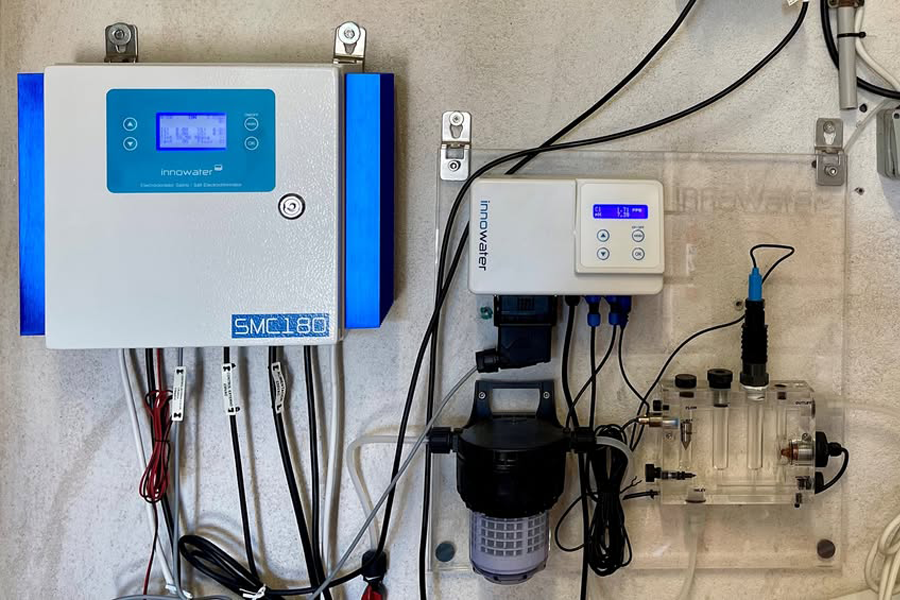
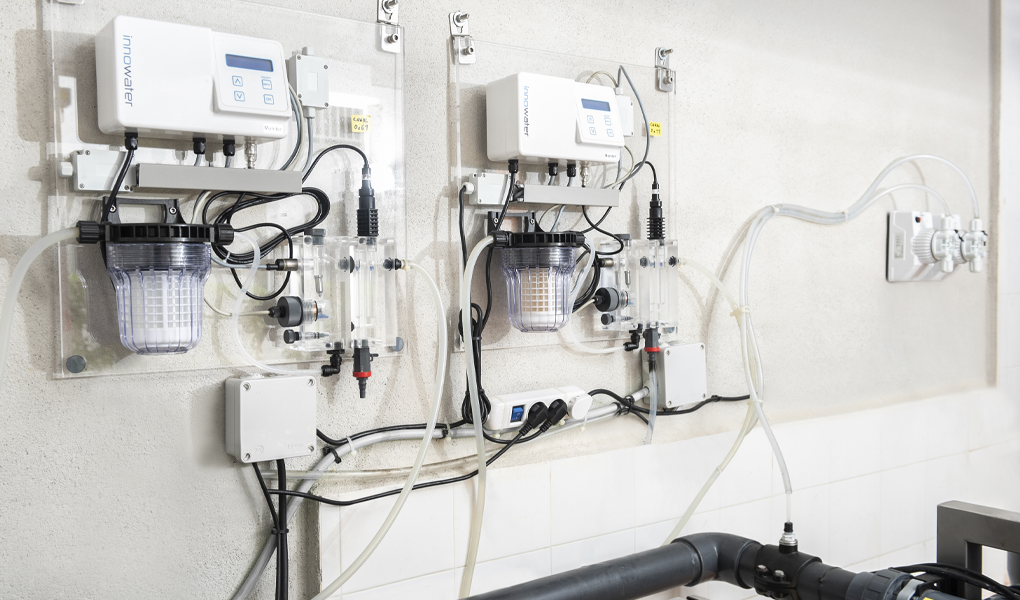
Innowater’s Monitor controller lets us measure pH and Redox potential and dose automatically. It also has communication and monitoring options for integration into management systems.
The role of ORP in a public pool
Redox potential, or ORP, provides different information than a simple free chlorine measurement. While free chlorine indicates a given concentration of disinfectant, ORP lets you assess the water’s oxidizing potential.
In a public installation, where disinfectant demand can vary considerably throughout the day, having a continuous reference for disinfection status allows the treatment to be managed with greater precision. For this reason, at Innowater we always recommend complementing industrial (commercial) salt chlorinators with control and dosing systems.
“The right salt chlorinator isn’t chosen based on the pool’s volume, but on the actual conditions it will have to work under”
Salt chlorinator and automatic dosing must form a single system
One of the common mistakes is treating the salt chlorinator as a piece of equipment independent from the rest of the treatment.
In reality, the larger the installation, the more important it is for all the elements to be properly coordinated.
A professional system can integrate:
- Filtration
- Salt chlorination
- pH control
- ORP control
- Dosing
- Monitoring
The main advantage is that each element performs a specific function and all of them work on the same treatment process:
- The chlorinator produces the disinfectant.
- The control system monitors the parameters.
- Dosing corrects pH when needed.
- Monitoring allows the installation’s status to be tracked.
Current systems can also incorporate remote communications and monitoring, which is especially useful when managing several installations or when the maintenance manager needs to check the system’s status without being physically in front of the control panel.
One cell or several: when to consider it
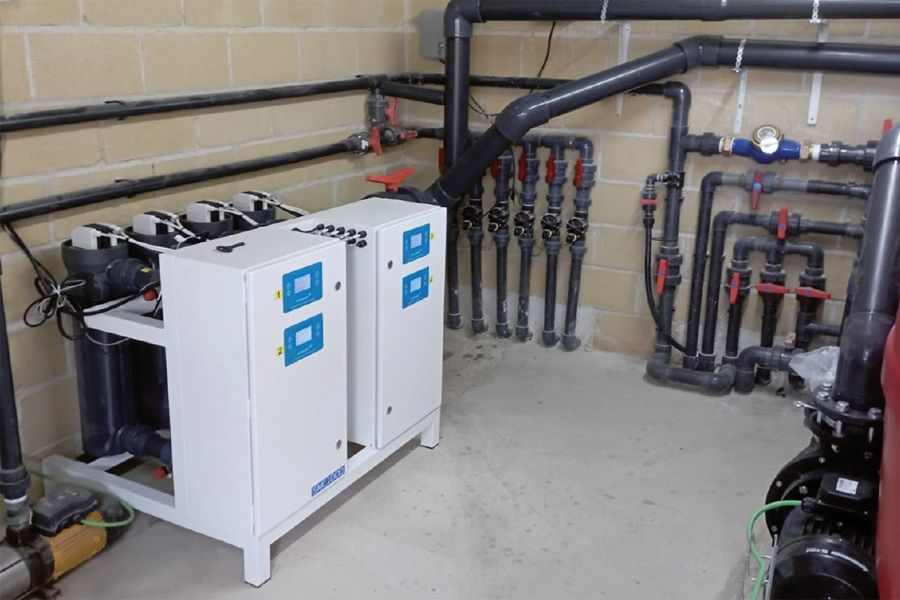
When production demand increases, the best solution isn’t always to look for a single higher-capacity cell. In large installations, it can be worthwhile to work with several units.
This configuration can make maintenance easier and allow for greater flexibility during the installation’s operation. It can also be especially useful in projects where service continuity is highly important.
Among the installations we’ve carried out, we have several examples of public pools using more than one salt chlorinator. For example, Aquapark Camping Las Dunas, with two SMC500 units, or Hotel Fido Gardens, with an SMC750 and an SMC500.
The final configuration will depend on each project’s hydraulic and operational characteristics.
Water flow rate also affects the installation
In a pool, it’s not enough for chlorine production to be sufficient. The cell needs to operate with an adequate water flow rate.
For example, the different SMC-H models have different minimum flow rates: from 15 m³/h in the 250 and 300 g/h models up to 60 m³/h in the SMC-H 1000.
This means the design must simultaneously check the required production and the installation’s hydraulic conditions.
Correctly selecting the chlorinator and then discovering the hydraulics aren’t suitable is a problem that can be avoided at the project stage.
Salt concentration must also be part of the project
Innowater’s professional chlorinators are designed to work with a salt concentration of approximately 4 g/l, depending on the model and specifications.
Therefore, before putting an installation into operation, it’s necessary to check that the salt concentration matches the equipment’s specifications.
It’s never advisable to add salt based solely on a rough estimate. The actual water volume and existing concentration must be checked to determine the amount needed.
Which equipment to use depending on the installation size
The final choice will always depend on the project, but Innowater’s professional ranges provide a good starting point.
- For medium-sized public pools with intensive use, the SMC-M range covers outputs from 75 to 180 g Cl₂/h.
- When production needs are higher, the SMC-H range covers from 250 up to 1,000 g Cl₂/h and is designed for large public pools with intensive use.
However, the model shouldn’t be selected based on its rated capacity alone. You also need to check the available flow rate, filtration hours, volume, number of users, and expected operating conditions.
The mistakes that cause the most problems in a project
There are a few mistakes that keep coming up when sizing a salt chlorination installation.
- The first is choosing the equipment based solely on the cubic meters of water.
- The second is using data from a private pool to size a public pool. Operating conditions are too different to apply the same criteria directly.
- It’s also common not to account for filtration hours, to overlook the expected peak attendance, or to treat the pH and ORP control system as a secondary element.
- Another problem arises when equipment is selected without checking the hydraulic conditions the cell requires.
- And there’s one last mistake that can be especially costly: designing the installation with only average conditions in mind.
A public pool must be prepared to operate correctly even during periods of peak demand.
What information an installer should have before ordering a chlorinator
Before requesting a proposal for a professional installation, it’s worth putting together a basic data sheet with all the relevant information:
Pool data
- Pool volume.
- Type of pool.
- Outdoor or indoor.
- Usual temperature.
- Operating season.
Operational data
- Daily bathers.
- Occupancy peaks.
- Operating hours.
- Filtration hours.
Hydraulic data
- Filtration flow rate.
- Pipe diameter.
- Working pressure.
- Circuit configuration.
Treatment
- Current disinfection system.
- pH control.
- ORP control.
- Dosing.
- Need for remote monitoring.
With this information, it becomes much easier to determine the required production capacity and propose a complete solution.
Designing the system with the whole installation in mind, not just the salt chlorinator
A good salt chlorination project doesn’t end once the equipment is selected. The salt chlorinator is one part of the treatment system and must work correctly together with the filtration, hydraulics, parameter control, and dosing.
The difference between installing a piece of equipment and properly designing a system lies right there.
In a public pool, where water quality, service continuity, and ease of maintenance matter enormously, it’s worth taking the time needed for proper sizing before deciding on a model.
Innowater’s professional ranges cover everything from medium-sized public installations to large, intensively used pools, with SMC-M equipment of up to 180 g Cl₂/h and SMC-H of up to 1,000 g Cl₂/h.
The final selection should always be based on the installation’s actual characteristics and operating conditions.
Salt chlorination specialists
At Innowater, we develop salt chlorination, control, and dosing systems for private and public pools, with solutions tailored to each installation’s needs.
If you’re planning a public pool at a hotel, sports center, school, municipal facility, or homeowners’ community, the first step is to correctly define the treatment requirements. From there, you can determine the most suitable production capacity, hydraulic configuration, and control system.
Innowater. Salt Chlorination Specialists.

Salt chlorination for pools is a treatment system that generates pure chlorine from the salt dissolved in the water, through an electrolysis process. A sustainable, automated, and safe treatment for swimming.
Related News
Potential Problems with a Salt Chlorinator: Causes and Solutions
Bipolar cells, reverse polarity and programmable polarity in salt chlorination

Superchlorination or Boost Function in a Salt Chlorinator: What It Is, What It’s For, and When to Use It

Chloramines in Pools: What They Are, How They Form, and How to Eliminate Them
How to solve the 20 most frequent pool water problems
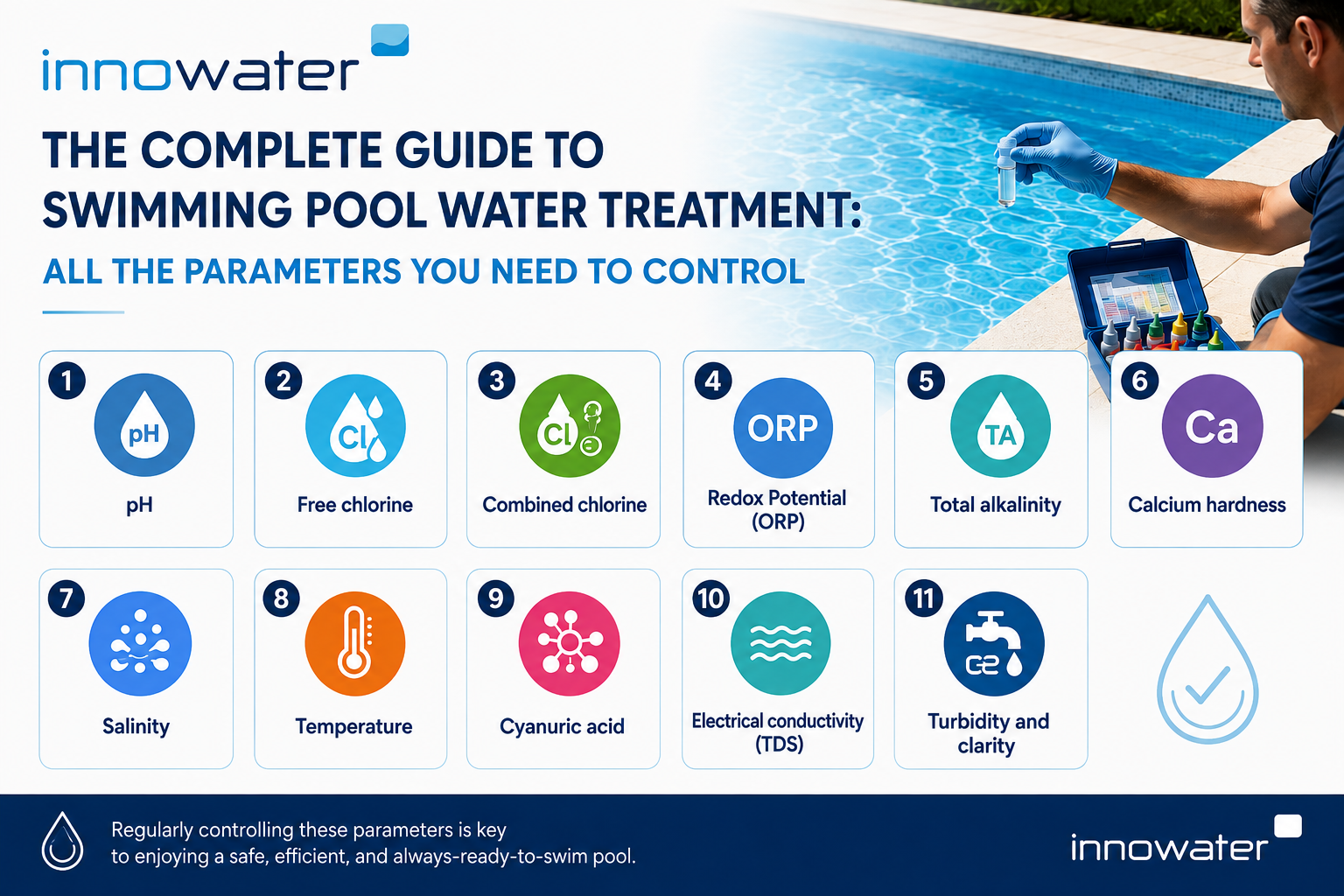
Complete guide to pool water treatment: all the parameters you need to control
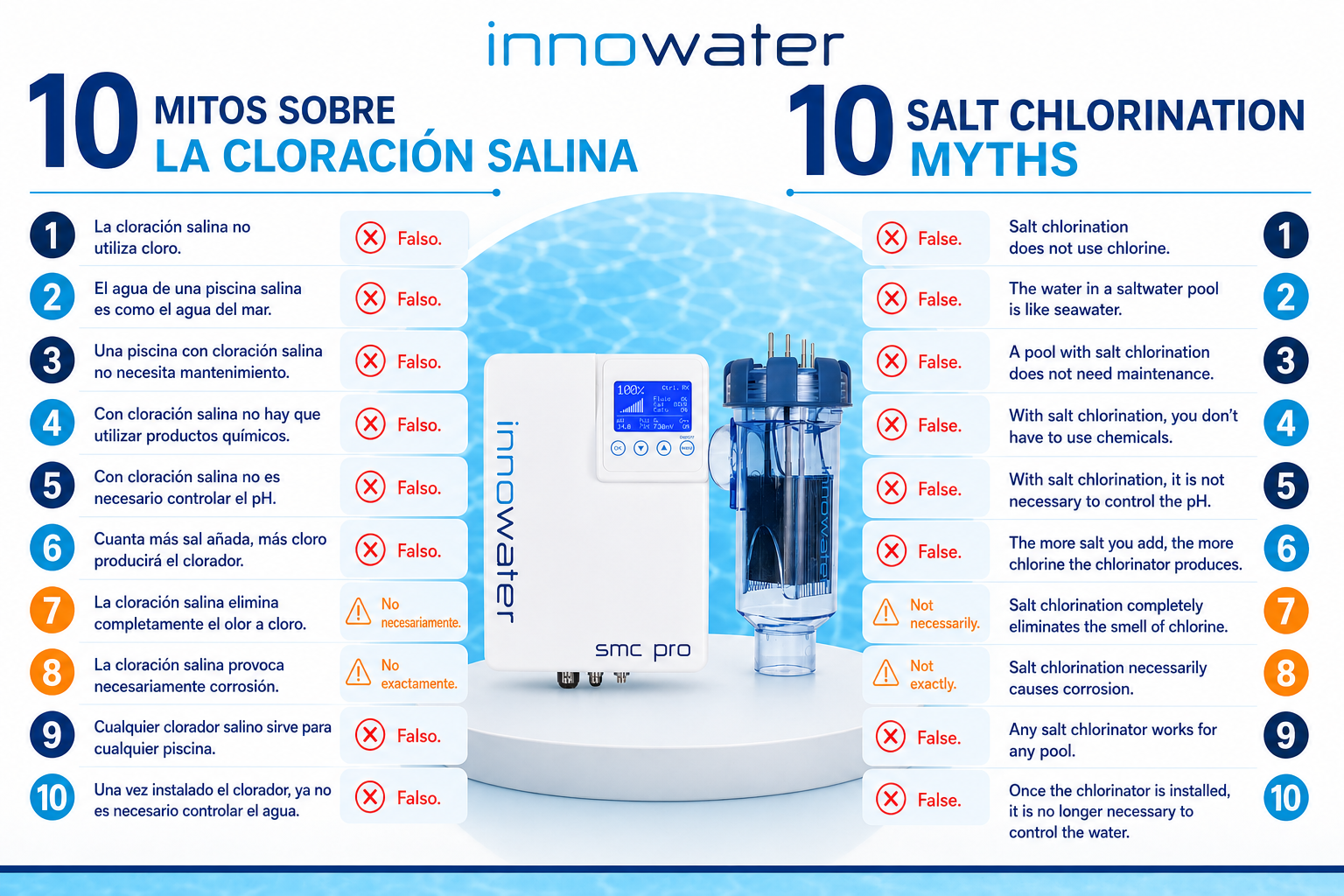
Myths about Salt Chlorination: 10 Misconceptions You Need to Know
Relationship between pH, ORP, and free chlorine: The ultimate guide to achieving effective pool disinfection
How to correctly size a salt chlorinator for your pool: the ultimate guide to choosing the right equipment