How to solve the 20 most frequent pool water problems
A pool may seem simple to maintain, but water is a chemical system in constant evolution. Temperature, solar radiation, the number of swimmers, organic matter, filtration, pH, chlorine, alkalinity, and other different parameters interact with each other.
Therefore, when the water changes color, turbidity appears, there is a chlorine odor, irritations occur, or the disinfectant disappears quickly, it is not always enough to add more chemical product.
The key lies in first identifying the cause and checking the main water parameters.
Chlorine and pH constitute two of the main barriers to keeping water correctly disinfected, and they must be controlled periodically. Furthermore, pH directly influences chlorine effectiveness: as it increases, its disinfecting capacity decreases.
Below we review the 20 most frequent pool water problems, their most common causes, and how to solve them.
1. Green water
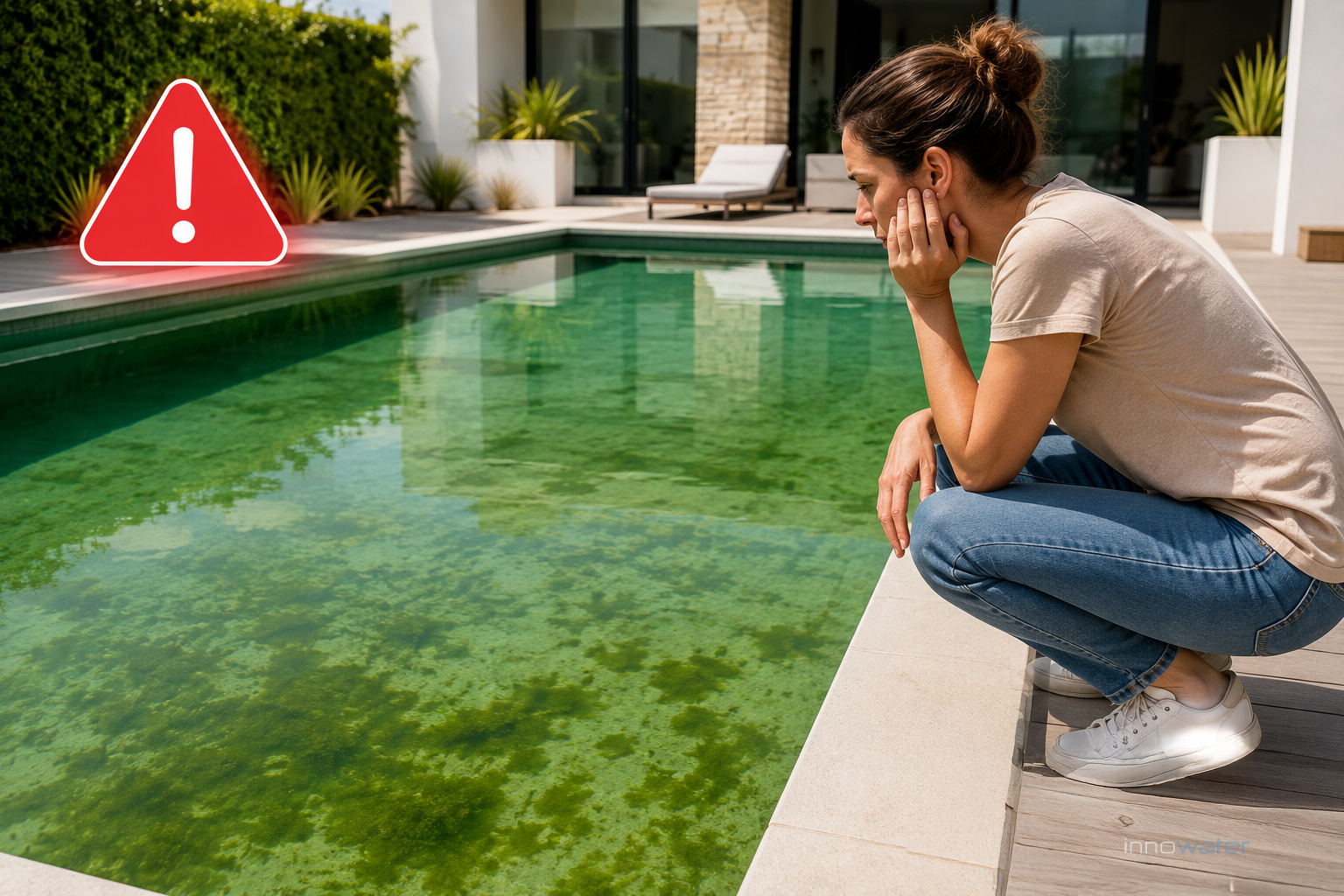
Why does pool water turn green?
Green water is usually related to algae blooms, generally favored by insufficient disinfection.
These are the most common causes:
- Insufficient chlorine level.
- pH outside the proper range.
- Insufficient filtration.
- High temperature.
- Accumulation of organic matter.
- Lack of maintenance.
- Insufficient or incorrect operation of the salt chlorinator.
In a pool with salt electrolysis, green water can be a sign that disinfectant production is not sufficient for the actual water demand. Innowater identifies algae and microorganism blooms associated with insufficient chlorine concentration as a common cause of the greenish appearance.
How to solve it?
These are the most recommended steps to follow:
- Analyze the pH and free chlorine.
- Correct the pH first.
- Clean the walls and floor by brushing and vacuuming.
- Check the filter status.
- Temporarily increase disinfection according to the recommended treatment for the pool.
- Maintain adequate filtration until transparency is recovered.
- Once the water is recovered, determine why the disinfectant level was insufficient.
Important note: adding products without previously checking pH, chlorine, and filtration may solve the problem temporarily, but will not prevent it from reappearing.
2. Cloudy water
Cloudy or whitish-looking water is one of the most frequent pool problems.
Main causes
- Insufficient filtration.
- Dirty or saturated filter.
- pH too high.
- High alkalinity.
- Excess organic matter.
- Mineral precipitation.
- Formation of particles too small for the filter to retain.
In pools with salt chlorination, it is also advisable to check that the salt concentration is adequate and that the system is functioning correctly.
How to clear cloudy water from a pool?
Check first: pH → disinfectant → filtration → alkalinity → salinity
Clean or perform the corresponding maintenance on the filter and prolong filtration if necessary. If there are very fine particles that are not being retained, it may be necessary to use a specific clarification or flocculation treatment compatible with the system.
Innowater points to incorrect filtration operation and high pH or alkalinity values as the most common causes of cloudy water.
3. White or milky water
Although it can be confused with cloudy water, white or milky water usually has a particularly opaque appearance, as if there were small suspended particles.
Why does pool water turn white or milky?
Possible causes include:
- Precipitation of mineral salts.
- High calcium hardness.
- pH too high.
- High alkalinity.
- Excess chemical products.
- Poor filtration.
- Air entering certain hydraulic systems.
What to do?
The first thing is to measure:
- pH.
- Alkalinity.
- Calcium hardness.
- Chlorine.
- Salinity, if salt chlorination is used.
Logically, it is not advisable to add products at random. If the problem is related to a chemical imbalance, it is necessary to correct the responsible parameter and maintain adequate filtration.
4. Yellowish water
Yellow water can have different origins and does not always mean a lack of chlorine.
It may be due to:
- Presence of metals, especially iron.
- Organic matter.
- Pollen and plant debris.
- Disinfection problems.
- Certain types of algae.
- Source water with a specific mineral composition.
How to identify the origin of yellowish water?
Analyze the water and observe when the coloring appears.
If it appears after adding well water or water from a source with a high concentration of minerals, it is advisable to study the quality of the source water.
If it coincides with a decrease in disinfectant and slippery walls or deposits, a possible proliferation of microorganisms should also be investigated.
Not all colored water is solved by increasing chlorine. First, you must identify what is causing the coloring.
5. Strong chlorine odor
One of the great pool myths is that a strong chlorine odor means there is too much chlorine.
Why does my pool smell strongly of chlorine?
In reality, an intense odor can be related to the presence of chloramines, compounds that form when chlorine reacts with organic matter and contaminants introduced by swimmers.
Chloramines can produce odor and also irritate eyes, skin, and respiratory tracts.
How to solve it?
It is important that you check the following:
- Free chlorine.
- Total chlorine.
- Combined chlorine.
- pH.
- Bather load.
- Filtration.
- Water renewal.
The simple calculation for combined chlorine is: Combined chlorine = total chlorine − free chlorine
When there is a significant accumulation of chloramines, it may be necessary to perform an oxidation or superchlorination treatment following the system instructions and applicable regulations.
In indoor facilities, ventilation is also essential to avoid the accumulation of chloramines in the air.
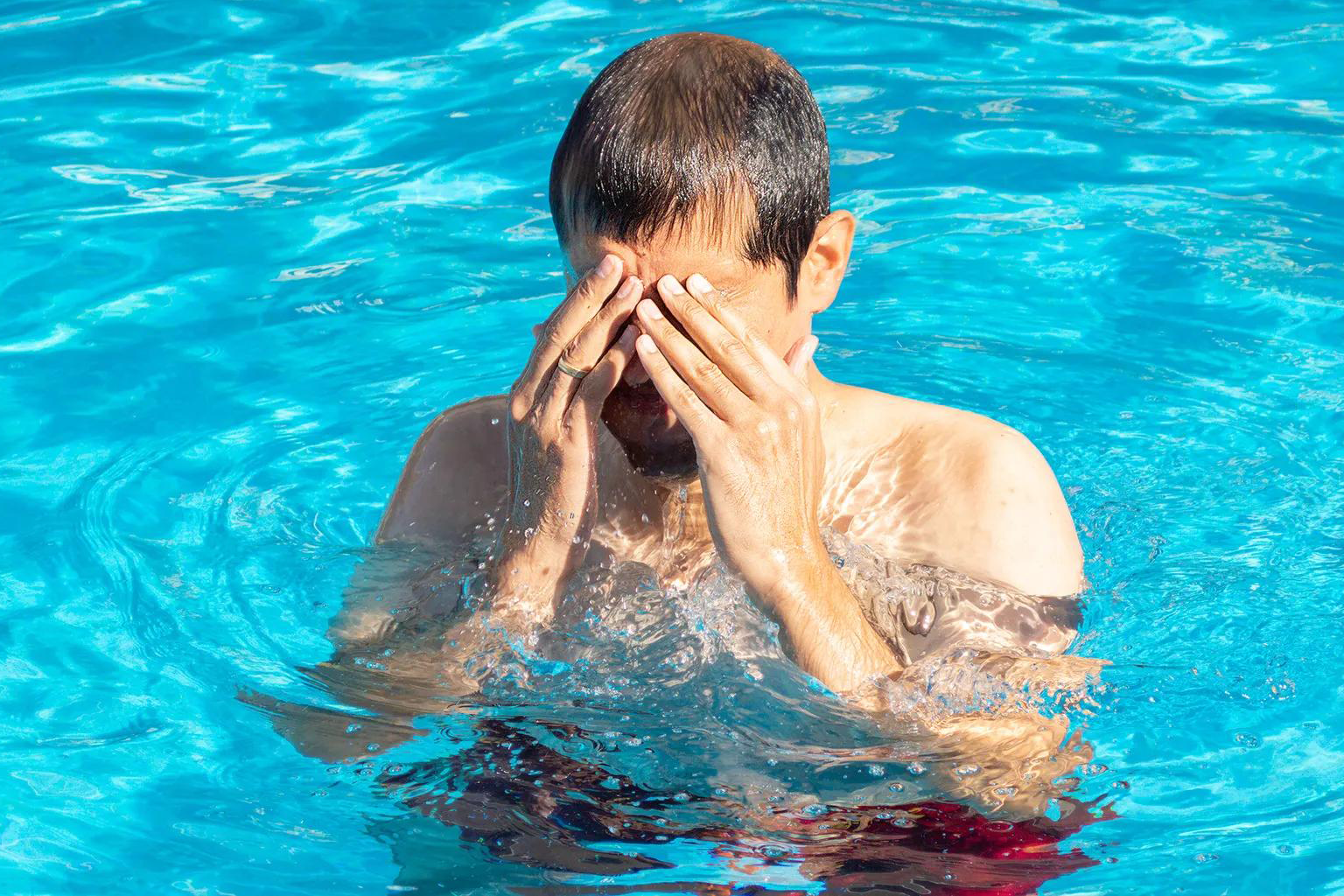
6. Eye irritation
Why do my eyes sting after swimming in the pool?
Stinging, itching, or redness of the eyes after swimming can have several causes. The most frequent are:
- pH too high or too low.
- High presence of chloramines.
- Disinfectant outside proper levels.
- Contaminants introduced by swimmers.
An incorrect pH can affect both the effectiveness of the disinfectant and the comfort of users. The CDC recommends maintaining the pH within 7.0–7.8 for domestic pools as a general reference, although target values should be adapted to the type of facility, treatment system, and applicable regulations.
What to do?
- Measure the pH.
- Measure free chlorine and combined chlorine.
- Correct the pH if it is outside the recommended range.
- Investigate the presence of chloramines.
- Check the disinfection system.
It should not be automatically assumed that irritation means “too much chlorine.”
7. Skin irritation
Skin irritation usually has an origin quite similar to that of eye irritation. Therefore, we must check:
- pH.
- Free chlorine.
- Combined chlorine.
- Temperature.
- General water quality.
A pH imbalance can favor irritation and, furthermore, reduce the effectiveness of the disinfection process.
In pools with a high bather load, good hygiene before swimming also helps reduce the amount of sweat, cosmetics, and organic matter that reach the water and can subsequently react with chlorine.
8. pH too high
High pH is one of the most common pool water problems. When the pH increases too much, the following can happen:
- Chlorine loses effectiveness.
- Scaling may appear.
- Water may become cloudy.
- The risk of irritation may increase.
- It can affect the operation of certain equipment.
The CDC (Centers for Disease Control and Prevention) notes that as pH increases, the ability of chlorine to kill microorganisms decreases, especially above pH 8.0.
What to do if the pool pH is high?
We need to reduce the level, and for this, an appropriate pH reducer or minus product must be used, adjusting the value progressively following the manufacturer’s instructions.
If the pH keeps rising continuously, it is not enough to correct it over and over again. The cause must be investigated, especially:
- Alkalinity.
- CO₂ degassing.
- Water characteristics.
- Aeration.
- Dosing system operation.
Automation using a pH probe can help maintain the parameter much more stably.
9. pH too low
An excessively low pH means the water is too acidic. This can cause:
- Eye and skin irritation.
- Corrosion of metal elements.
- Damage to certain components.
- Greater aggressiveness on materials.
- Alteration of the water balance.
The WHO highlights that pH control is necessary to ensure effective disinfection, protect pool materials, and maintain user comfort.
How to solve it?
Measure the pH and use a pH increaser product when necessary, always following the manufacturer’s instructions.
If the pH drops repeatedly, it is important to investigate the alkalinity and the operation of the dosing system.
10. Chlorine too high
An excessive chlorine level can cause discomfort and also indicate that the dosing or generation system is oversized or running for too long.
Possible causes
- Overdosing.
- Chlorinator running too many hours.
- Production set too high.
- Recent shock treatment.
- Measurement error.
- Automatic regulation problems.
What to do?
First of all, confirm the result with a reliable measurement.
Afterwards:
- Temporarily reduce or stop generation/dosing according to the manufacturer’s instructions.
- Avoid adding more disinfectant.
- Allow the level to decrease in a controlled manner.
- Check the regulation system.
A single universal “correct chlorine” value should not be established for all pools: it depends on the type of facility, the system used, and the applicable regulations.
As a reference for residential pools, the CDC indicates at least 1 ppm of free chlorine when cyanuric acid is not used, and at least 2 ppm when this stabilizer is used.
11. Chlorine too low
A low chlorine level means that the disinfection capacity may be insufficient.
Why does chlorine drop?
Among the most common causes:
- Excessive bather load.
- High temperature.
- Solar radiation.
- Organic matter.
- Incorrect pH.
- Insufficient filtration.
- Insufficient production from the salt chlorinator.
- Insufficient running time.
- Problems in the electrolytic cell.
- Incorrect salt level.
Chlorine concentration can be reduced by factors such as sweat, dirt, sunlight, and other contaminants.
How to solve it?
Check first: pH + free chlorine + ORP + salinity + chlorinator operation + filtration
If it is a pool with salt electrolysis, it is not advisable to simply increase production without investigating why the system is not maintaining the necessary residual.
“Behind every pool water problem, there is a cause. Measuring, diagnosing, and balancing is the key to solving it.”
12. Low Redox Potential (ORP)
The ORP (Oxidation-Reduction Potential) or Redox potential allows for the evaluation of the water’s oxidizing capacity.
What does it mean to have a low Redox potential in a pool?
A low Redox potential can indicate that the water’s oxidation and disinfection capacity is not sufficient, but it should not be interpreted in isolation.
Possible causes of a low Redox Potential
- Low disinfectant level.
- High pH.
- High organic load.
- Circulation problems.
- Dirty probe.
- Uncalibrated probe.
- Installation problems.
- Influence of certain stabilizers.
- Insufficient time for the system to reach the target value.
What to do?
- Check the pH.
- Check the free chlorine.
- Check the water circulation.
- Clean and inspect the ORP probe.
- Check its calibration and condition.
- Analyze the organic load.
- Check the operation of the dosing or chlorination system.
The great advantage of Redox Potential (ORP) is that it allows for the analysis of the water’s oxidizing capacity, complementing the information provided by the free chlorine measurement.
Therefore, the relationship between pH, ORP, and free chlorine is especially important for achieving effective disinfection.
13. Algae formation
Algae appear when they find favorable conditions to grow.
These include:
- Insufficient disinfection.
- Poor circulation.
- Areas with little water renewal.
- High temperatures.
- Accumulated dirt.
- Deficient filtration.
How to prevent them?
Prevention is much more effective than trying to eliminate a major bloom once established. Maintain:
- Adequate disinfectant.
- Correctly adjusted pH.
- Sufficient filtration.
- Good circulation.
- Periodic cleaning.
- Water control.
Why do algae appear in a pool with salt chlorination?
In pools with salt chlorination, it is important to periodically check that the chlorinator is producing correctly and that the cell, flow, and salt concentration are adequate. If not, algae could also appear in the water.
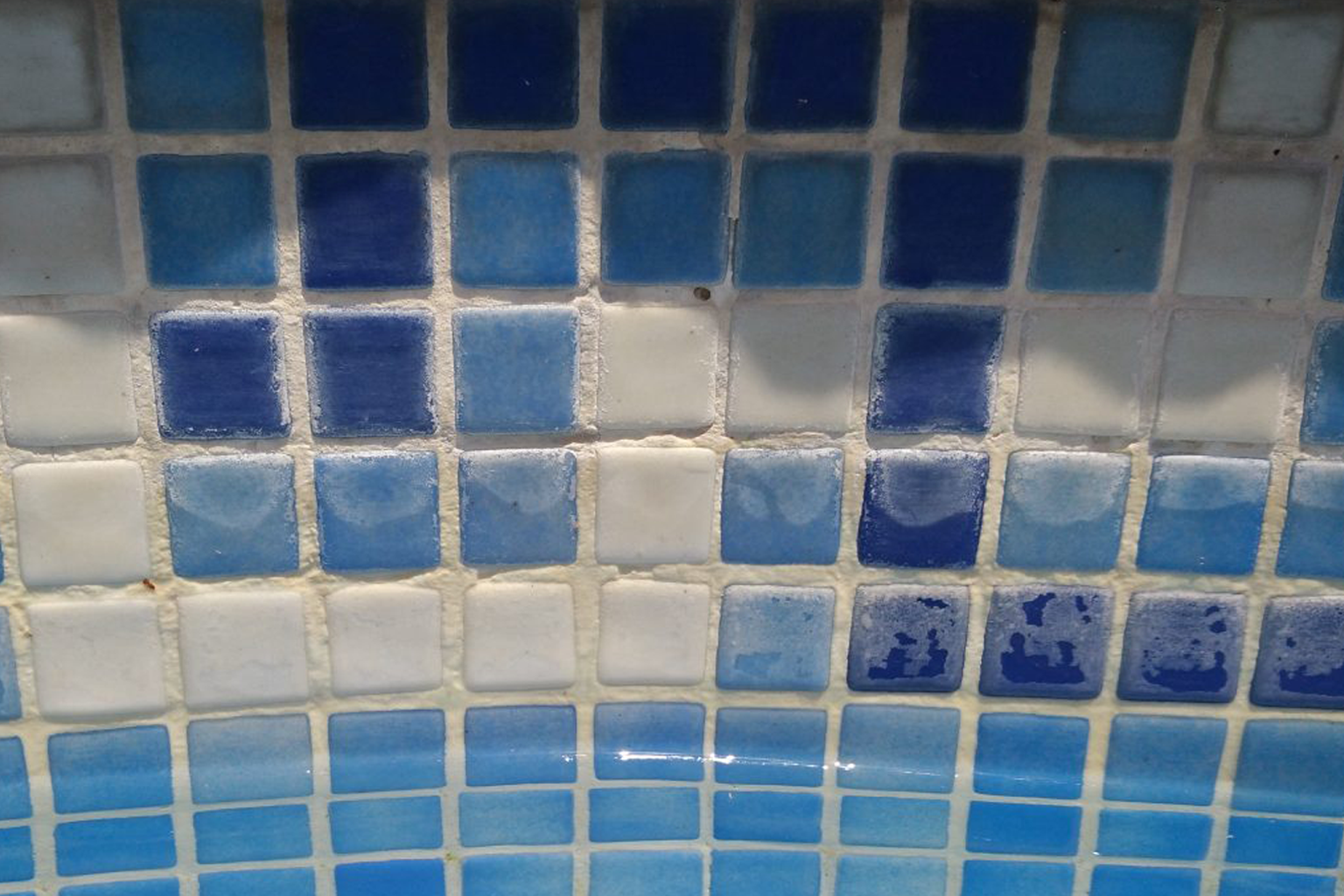
14. Scaling
Scaling usually appears as white or calcareous deposits on walls, accessories, pipes, or especially in the cell of a salt chlorinator.
Why does scaling appear in the pool?
The main factors can be:
- High pH.
- High calcium hardness.
- High alkalinity.
- High temperature.
- Incorrect chemical balance.
How to prevent it?
Regularly control: pH + alkalinity + hardness + temperature
In a salt chlorinator, scaling on the electrodes can reduce the cell’s performance.
Limescale deposits can even cause insufficient salt indications or affect the system’s reading. Therefore, it is essential to perform cell maintenance following the manufacturer’s specific instructions.
15. Corrosion
Corrosion is not an inevitable consequence of salt chlorination. It can occur when inadequate chemical or electrical conditions exist.
Possible causes include:
- pH too low.
- Chemically imbalanced water.
- Excess salt.
- Poor grounding.
- Stray currents.
- Inadequate materials.
- Incompatible metal installations.
- Lack of maintenance.
A pH that is too low increases the risk of corrosion of pipes and components, according to the CDC.
How to avoid it?
Keep the water within the recommended parameters and ensure that the hydraulic and electrical installation is suitable for a pool with salt electrolysis.
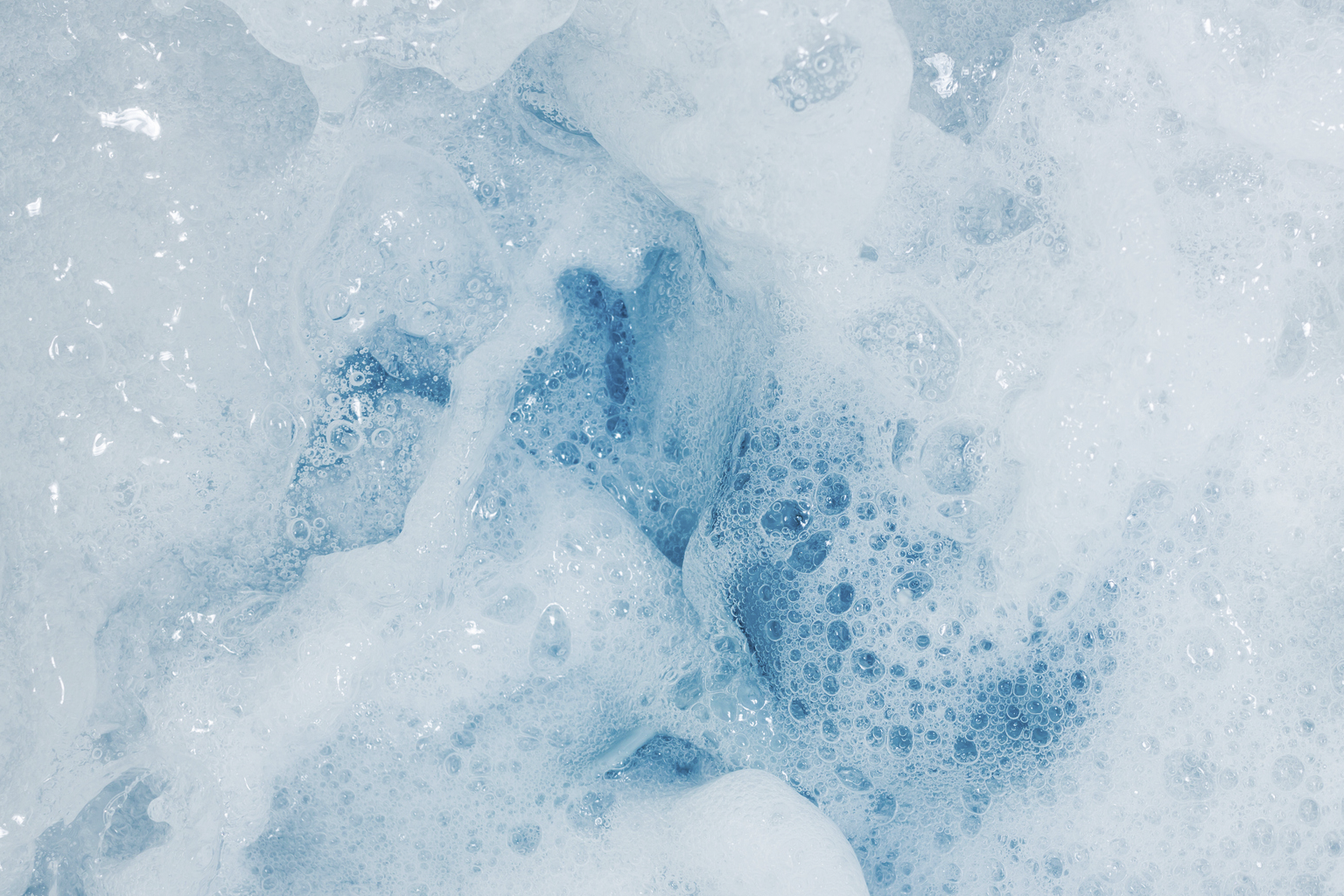
16. Foam in the water
A thin layer of foam may appear occasionally, but persistent foam usually indicates the presence of surfactants or an accumulation of certain products.
Possible causes
- Excess algaecide.
- Cosmetics.
- Sun creams.
- Cleaning products.
- Organic matter.
- Water with a high pollutant load.
At Innowater, we identify the excess of certain algaecides as a common cause of foam appearance.
What to do?
- Check the water balance.
- Review recently used products.
- Clean the filter.
- Maintain adequate filtration.
- Avoid overdosing chemical products.
- Consider a partial water renewal if the problem persists.
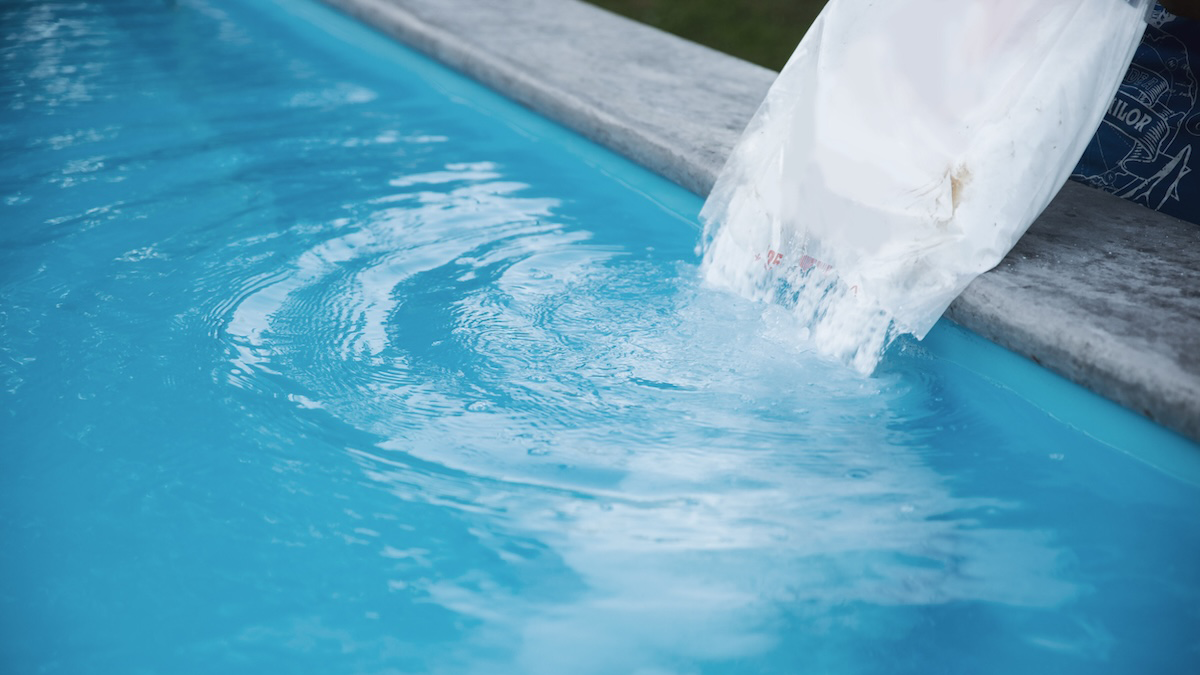
17. Water with excess salt
A salt concentration that is too high can affect the system’s operation and increase the water’s conductivity.
How does an excessive salt concentration occur in the water?
It is most likely due to one of these reasons:
- Adding more salt than necessary.
- Not measuring before performing a replenishment.
- Water evaporation without equivalent salt loss.
- Incorrectly calculated partial renewals.
Water evaporation does not remove salt in the same proportion, so adding water without subsequently controlling the concentration can alter the balance.
How to solve it?
Salt is not removed simply by waiting. The usual solution when the concentration is excessive consists of performing a partial renewal with salt-free water and measuring again.
We should never add more salt to the pool without first checking the existing concentration in the water.
18. Water without enough salt
In a pool with salt chlorination, an insufficient concentration can prevent the chlorinator from working correctly or reduce its production capacity.
Possible causes
- Water loss.
- Partial renewal.
- Heavy rains.
- Leaks.
- Measurement error.
- Insufficient addition during startup.
What to do if the salt chlorinator indicates a lack of salt?
- Measure the salinity.
- Check the manufacturer’s specifications.
- Calculate the necessary amount according to the water volume.
- Add salt of appropriate quality.
- Let the water circulate.
- Measure again before making new corrections.
Not all chlorinators work with the same salt concentration. The correct value must always be the one indicated for the installed model.
Furthermore, a “low salt” indication does not necessarily mean that salt is missing. A low reading can also be related to limescale deposits on the electrodes or the presence of air in the electrolytic cell.
19. Chlorine disappears quickly
If you add chlorine and a few hours later the level is very low again, there is probably a high chlorine demand or a problem in the disinfection system.
Why does my pool chlorine drop so fast?
The most common causes of this problem are usually:
- High bather load.
- Organic matter.
- Algae.
- Contaminated water.
- Intense solar radiation.
- High temperature.
- Incorrect pH.
- Presence of certain stabilizers.
- Insufficient chlorinator production.
- Dosing problems.
How to diagnose it?
Do not limit yourself to measuring chlorine. Check: pH → free chlorine → combined chlorine → ORP → temperature → stabilizer → filtration
If chlorine constantly disappears, you have to find out what is consuming it.
In a pool with salt chlorination, it is also necessary to check the actual production of the cell, the running time, the salt concentration, and the water flow.
20. The water turns green again
This problem deserves an explanation independent of the first point.
A pool can recover after a green water episode and turn green again a few days or weeks later. This normally means that the symptom has been solved, but not the cause.
Why does a pool turn green again after cleaning it?
Here are some of the most common causes:
- Insufficient chlorine production.
- Insufficient filtration.
- Uncontrolled pH.
- Poor circulation.
- Dead zones in the hydraulic circuit.
- High temperature.
- Accumulation of organic matter.
- Problems in the salt chlorinator.
- Lack of periodic control.
The solution is not to add more algaecide
If the pool water turns green again, a complete diagnosis must be performed:
- Measure pH.
- Measure free chlorine.
- Measure combined chlorine.
- Check ORP.
- Check salinity.
- Review the chlorinator.
- Review the cell.
- Check filtration.
- Check circulation.
- Review the daily running time.
The main objective should be to stably maintain the necessary conditions to prevent algae growth, not simply to eliminate algae every time they appear.
The key: do not treat the symptoms, but understand the water
The 20 problems above may seem different, but many have a common origin: the imbalance between disinfection, pH, circulation, filtration, and pollutant load.
Therefore, when a pool presents a problem, it is advisable to always follow a logical diagnostic order.
1. Check the pH
The pH conditions the effectiveness of the disinfection process and also influences the comfort of swimmers and the protection of materials.
2. Check the free chlorine
Allows you to know how much disinfectant is available in the water.
3. Check the combined chlorine
A high level can indicate an accumulation of chloramines.
4. Check the Redox Potential (ORP)
The Redox potential provides additional information on the water’s oxidizing capacity and can be used to automate disinfection control.
5. Check the filtration
Chemically balanced water also needs correct filtration and circulation.
6. If you use salt chlorination, check the salinity and the chlorinator
The salt concentration must be adjusted to the equipment specifications and it must be verified that the cell, flow, and control system are working correctly
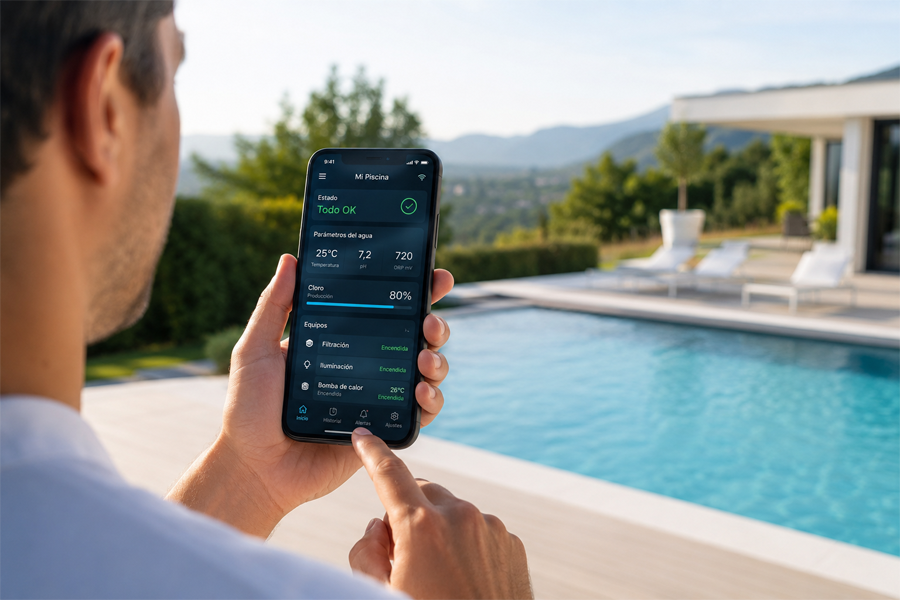
Can automation avoid many of these problems?
Yes, although no automation system eliminates the need for maintenance.
Automation allows for the measurement of certain parameters continuously or frequently and acting on them through regulation and dosing systems. For example, a control system can:
- Measure the pH.
- Measure the ORP.
- Automatically regulate the pH.
- Control chlorine production.
- Adjust the dosage.
- Generate alarms.
- Detect certain incidents.
- Facilitate remote control.
This allows for a shift from maintenance based exclusively on occasional measurements to a model of continuous and preventive control.
In public facilities, continuous measurement and automatic pH adjustment are even recommended as a management strategy, given the intensity of use of these facilities.
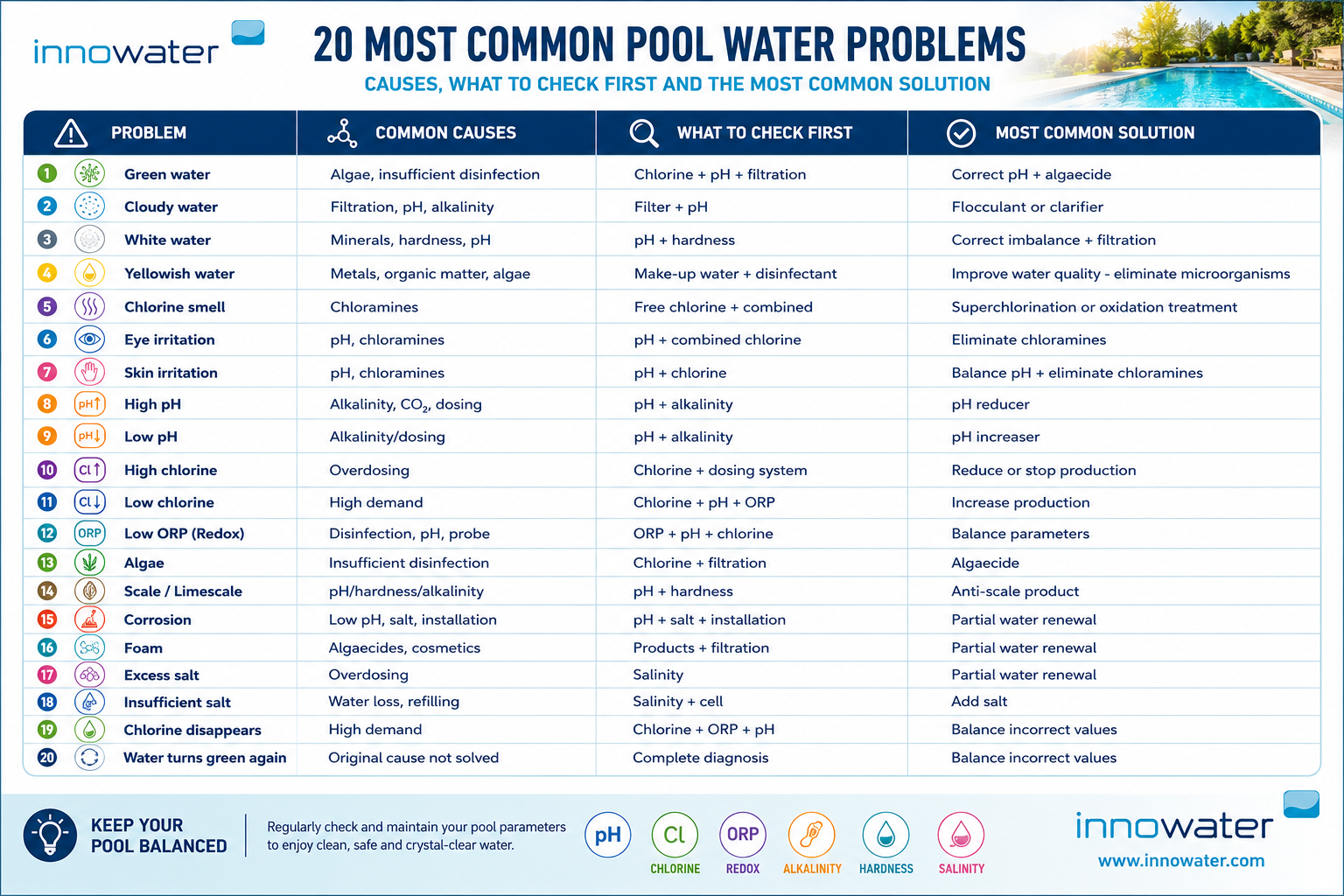
Summary table: pool water problems and solution
| Problem | Common causes | What to check first | Most common solution |
| Green water | Algae, insufficient disinfection | Chlorine + pH + filtration | Correct pH + algaecide |
| Cloudy water | Filtration, pH, alkalinity | Filter + pH | Flocculant or clarifier |
| White water | Minerals, hardness, pH | pH + hardness | Correct imbalance + filtration |
| Yellowish water | Metals, organic matter, algae | Source water + disinfectant | Improve water quality – eliminate microorganisms |
| Chlorine odor | Chloramines | Free + combined chlorine | Superchlorination or oxidation treatment |
| Eye irritation | pH, chloramines | pH + combined chlorine | Eliminate chloramines |
| Skin irritation | pH, chloramines | pH + chlorine | Balance pH + eliminate chloramines |
| High pH | Alkalinity, CO₂, dosing | pH + alkalinity | pH reducer |
| Low pH | Alkalinity/dosing | pH + alkalinity | pH increaser |
| High chlorine | Overdosing | Chlorine + dosing system | Reduce or stop production |
| Low chlorine | High demand | Chlorine + pH + ORP | Increase production |
| Low Redox (ORP) | Disinfection, pH, probe | ORP + pH + chlorine | Balance parameters |
| Algae | Insufficient disinfection | Chlorine + filtration | Algaecide |
| Scaling | pH/hardness/alkalinity | pH + hardness | Anti-scale |
| Corrosion | Low pH, salt, installation | pH + salt + installation | Partial water renewal |
| Foam | Algaecides, cosmetics | Products + filtration | Partial water renewal |
| Excess salt | Overdosing | Salinity | Partial water renewal |
| Insufficient salt | Water loss, replenishment | Salinity + cell | Add salt |
| Chlorine disappears | High demand | Chlorine + ORP + pH | Balance incorrect values |
| Water turns green again | Original cause unresolved | Complete diagnosis | Balance incorrect values |
Conclusion
Maintaining pool water in good condition does not simply consist of adding chlorine when the water changes appearance.
Water quality depends on the balance between disinfection, pH, ORP, filtration, circulation, salinity, and pollutant load.
Therefore, faced with any problem, the first step must be to measure and diagnose, not to add products indiscriminately.
Salt chlorination can considerably simplify disinfectant management by generating chlorine through electrolysis, but the system must be correctly sized, installed, and regulated. Automatic control of parameters such as pH and ORP also allows for maintaining more stable treatment conditions and reducing dependence on manual adjustments.
In short, a healthy pool is not one in which a problem never appears, but one in which parameters are controlled, deviations are detected in time, and causes are corrected before they affect water quality.
At Innowater, we offer salt chlorination, control, and automation solutions for more efficient and safe water management in any pool.

Salt chlorination for pools is a treatment system that generates pure chlorine from the salt dissolved in the water, through an electrolysis process. A sustainable, automated, and safe treatment for swimming.
Related News
Bipolar cells, reverse polarity and programmable polarity in salt chlorination
Superchlorination or Boost Function in a Salt Chlorinator: What It Is, What It’s For, and When to Use It
Chloramines in Pools: What They Are, How They Form, and How to Eliminate Them
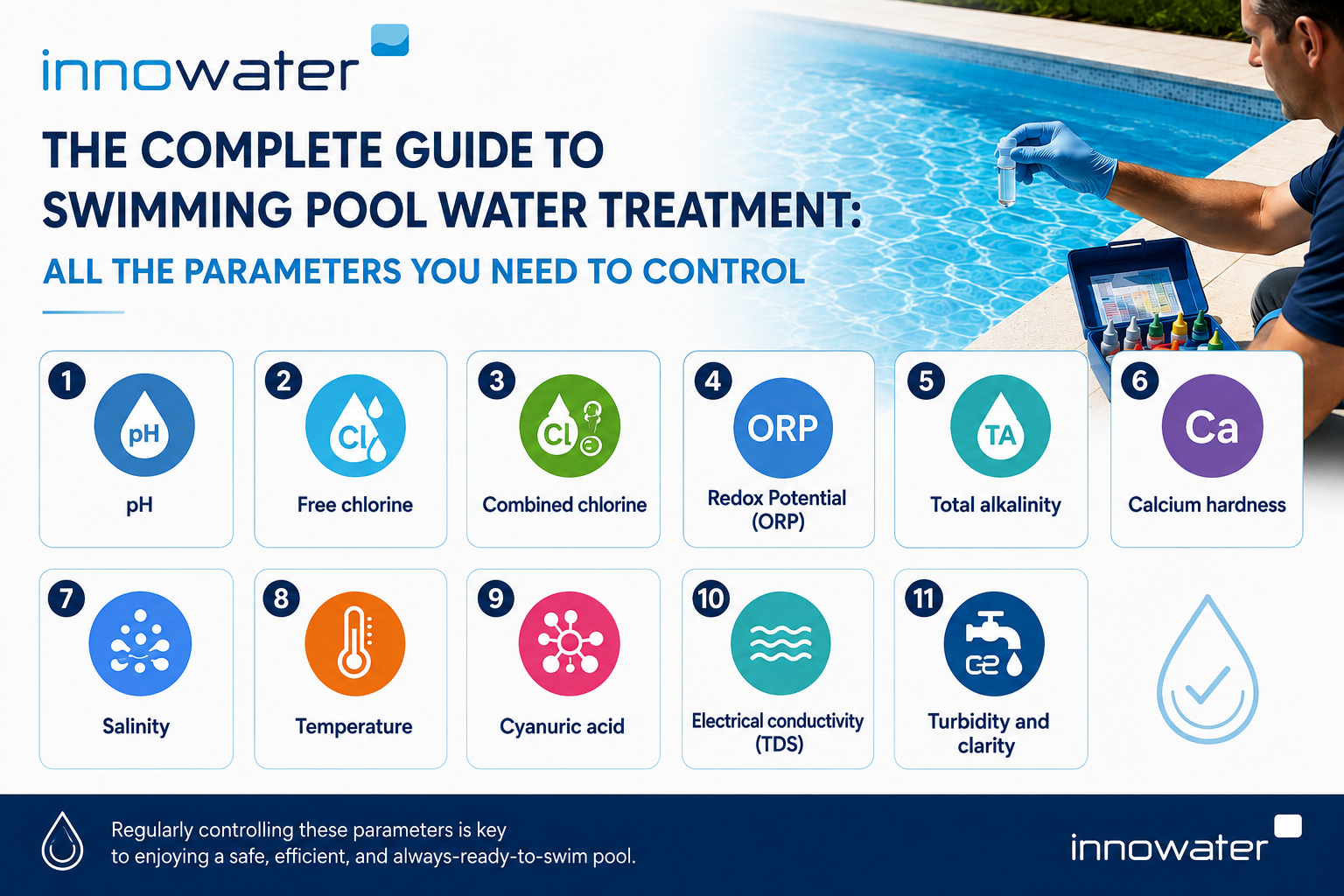
Complete guide to pool water treatment: all the parameters you need to control
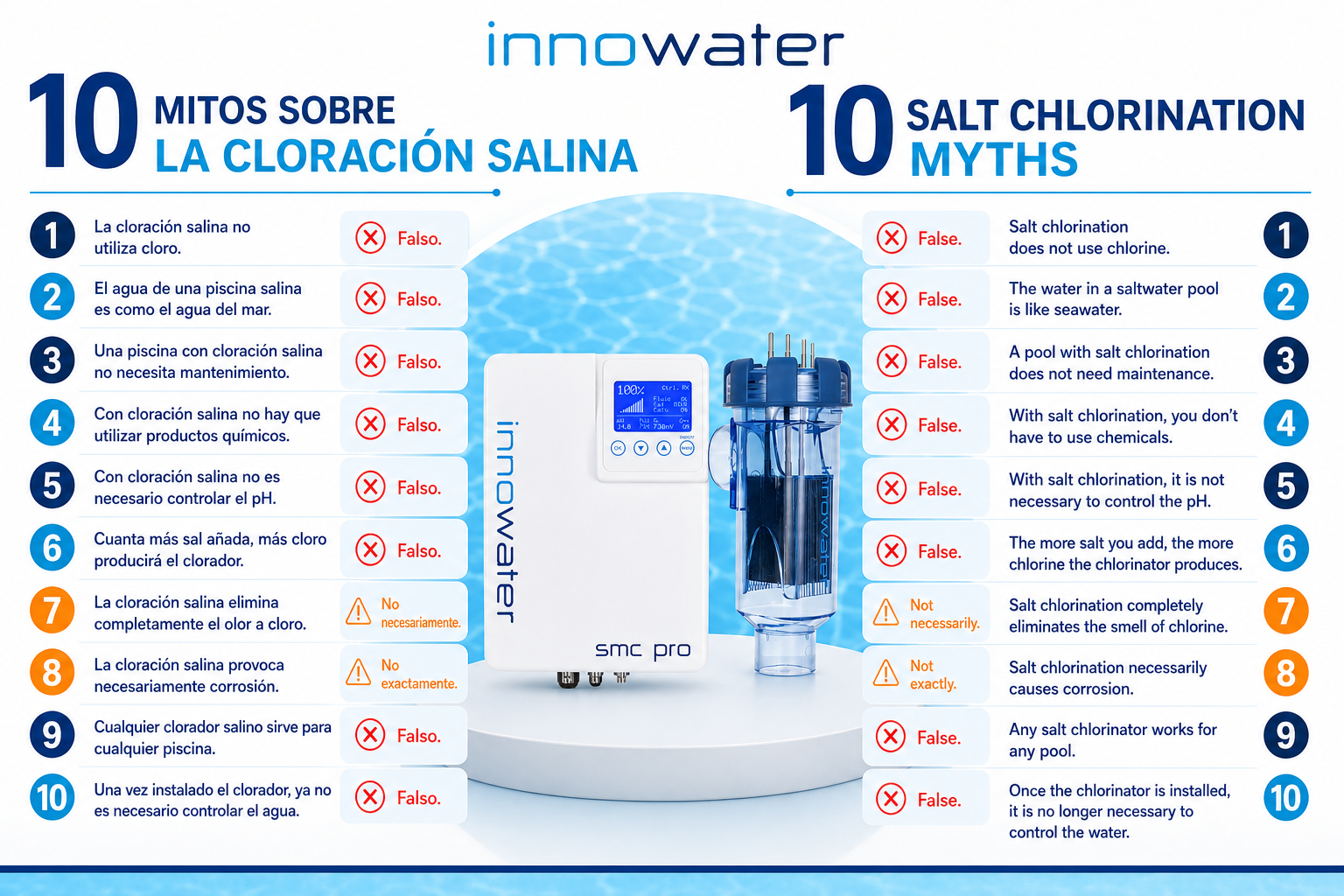
Myths about Salt Chlorination: 10 Misconceptions You Need to Know
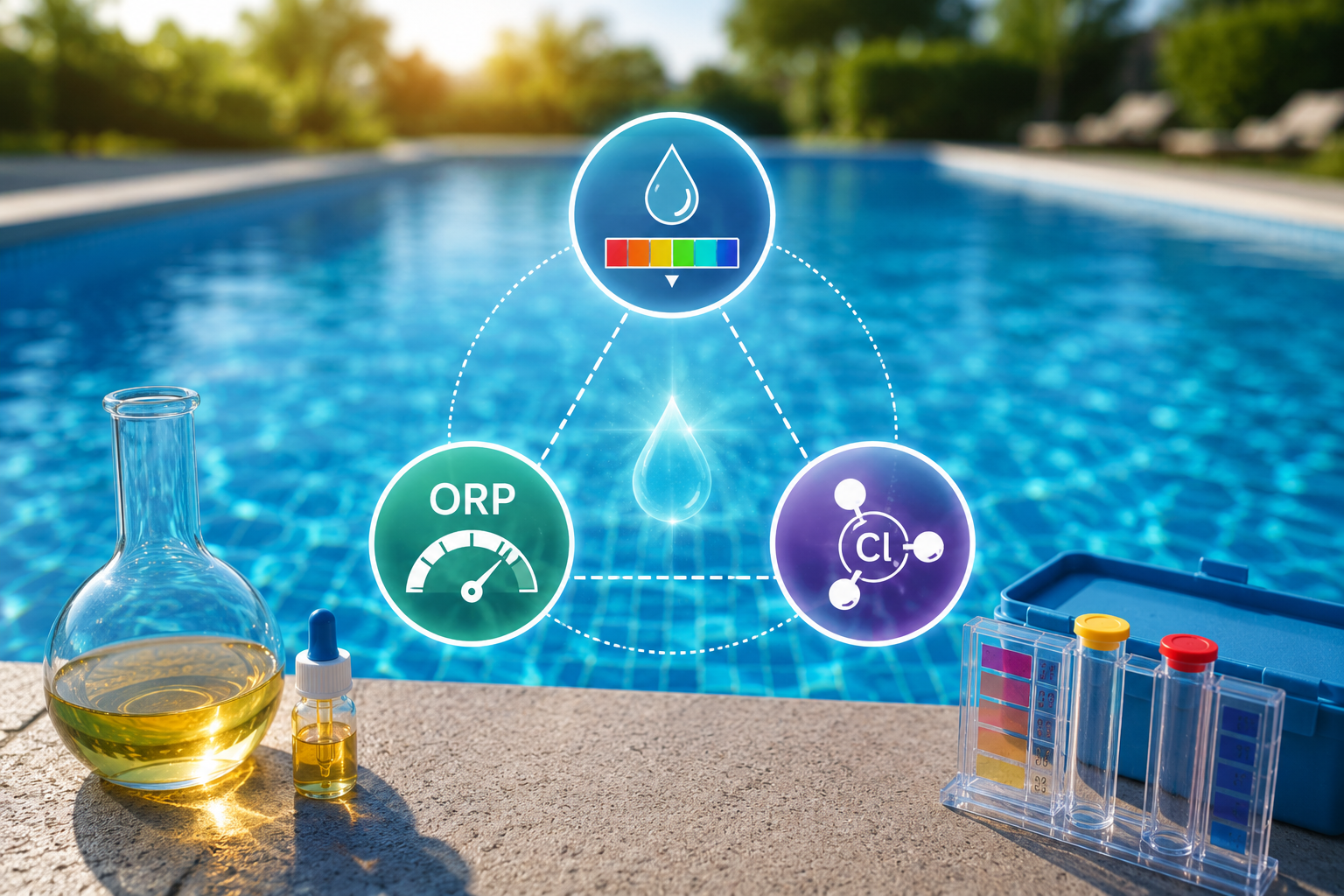
Relationship between pH, ORP, and free chlorine: The ultimate guide to achieving effective pool disinfection
How to correctly size a salt chlorinator for your pool: the ultimate guide to choosing the right equipment
What is ORP and why is it the most important parameter to ensure effective disinfection in a swimming pool?
Automating pool water treatment: greater efficiency, less maintenance, and consistently high water quality